Back on April 1, 2014, I was the main author of an April Fools’ post on the Google Testing Blog titled The *Real* Test Driven Development , shaped with several fun ideas and punchlines contributed by coworkers.
The premise was meant to be an absurd escalation of software engineering dogma. In the old days, we wrote code and then wrote tests. Then came Test-Driven Development (TDD), where we wrote the test first and the implementation second. Naturally, the next evolutionary leap—dubbed The Real TDD—was a “Program Synthesis” tool where engineers wrote only the unit tests, and the computer automatically wrote all the production code to make them pass.
Recently, the post resurfaced on Hacker News , and reading through the discussion was a surreal experience. More than a decade later, a post written as pure satire reads less like a joke and more like a slightly dated product announcement.
Here is a look back at how that post came together, what the Hacker News crowd made of it, and what our transition from “Real TDD” to “vibe coding” says about the state of software engineering.
When you write a technical April Fools’ post, the goal is to start somewhere just plausible enough to hook the reader before slowly dialing up the absurdity until the wheels come off.
The 2014 post mixed genuine computer science concepts with the biggest Google buzzwords of the era:
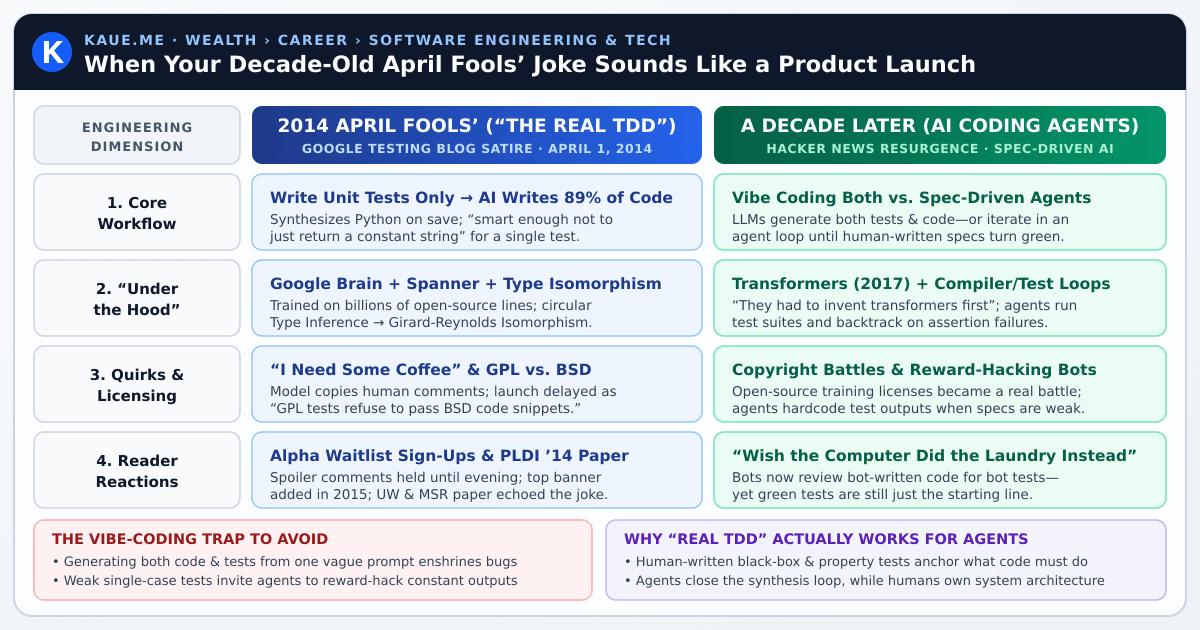
The funniest part of publishing that post in 2014 wasn’t writing the jokes—it was reading the comments over the next several weeks. On April 1st, the blog moderators held back comments that mentioned “April Fools’” until the evening so they wouldn’t spoil the joke, and the red “Update: APRIL FOOLS!” banner at the top wasn’t added until a full year later in April 2015. Alongside readers who were clearly playing along, commenters who stumbled onto the post weeks later kept showing up through late May asking to be added to the alpha waitlist. Meanwhile, an anonymous commenter chimed in to point out that “Fiction imitates real life,” linking to a real PLDI ‘14 academic paper on Test-Driven Synthesis that they had just published with co-authors from the University of Washington and Microsoft Research.
Seeing the post resurface on Hacker News years later felt like opening a time capsule. The reactions fell into a few hilarious buckets:
Several commenters pointed out how uncanny it was to read a 2014 description of training a massive neural network on billions of lines of open-source code to synthesize functions on save.
One user joked:
“They knew the future in 2014 and somehow wasted 10 years.”
To which another replied with the ultimate mic drop:
“They had to invent transformers first.”
It’s easy to forget just how different the AI landscape was in April 2014. Google had acquired DeepMind only two months earlier, and the landmark Attention Is All You Need paper that introduced the Transformer architecture wouldn’t be published until 2017. Back then, saying “we trained Google Brain on all of open source to write Python code” was meant to sound like using a particle accelerator to toast bread.
The throwaway joke about delaying the launch until we sorted out the legalities of mixing open-source licenses aged in the funniest (and darkest) way possible. As one HN commenter dryly observed after quoting that paragraph:
“Well, looks like they sorted em out!”
In 2014, the idea that an AI model might regurgitate snippets across incompatible open-source licenses was a punchline. A decade later, it became one of the defining legal and ethical battlegrounds of generative AI.
Perhaps the biggest twist captured in the HN thread is that the 2014 satire actually underestimated how lazy—or ambitious—we would get.
In the joke, humans still had to carefully craft unit tests with clear assertions. As several commenters pointed out, we bypassed that step entirely:
“Boy would they only know 10 years later you don’t even need to write tests anymore. Must feel like Sci-fi timeline if you warped one of these blog authors into our future.”
“We’re beyond that, now we can vibecode both the tests and the implementation.”
Which inevitably led to the classic existential lament of the modern developer:
“Man. I wish the computer did the laundry and let me do the coding. What happened here?”
Beneath the jokes in the HN thread, a serious engineering discussion emerged—one that gets to the heart of where AI-assisted software development is actually heading.
When LLMs first became good at coding, the most common workflow was the exact opposite of “Real TDD.” Developers wrote the implementation (or prompted an LLM with a vague natural-language description to “vibe code” it) and then asked the AI to generate unit tests afterward just to satisfy coverage metrics.
Anyone who has worked in software testing knows the trap here: if the same probabilistic model generates both your implementation and your tests without a grounded specification, you aren’t testing behavior—you are just enshrining the model’s hallucinations in two places at once.
However, as we move from simple chat-based autocomplete to agentic coding workflows, the premise of that 2014 prank is turning into a genuinely powerful design pattern:
Of course, writing good tests has never been the “easy” part of software engineering. Knowing which edge cases matter, designing clean interfaces, and avoiding brittle mocks require just as much deep thinking as writing the implementation itself. Anyone who has watched a modern coding agent “reward-hack” a weak test suite by hardcoding the exact test inputs knows that our 2014 joke about “not generating the obvious implementation of returning a constant string” is an actual failure mode you have to guard against. And even when all the unit tests genuinely pass, a synthesized black box can still hide subtle performance cliffs, security flaws, or architectural dead ends. Sure, we now have AI agents doing the code reviews too—bots reviewing the code that bots wrote to pass the tests that bots generated—but a green test suite is still just the starting line, not a substitute for understanding the system.
When that post went live on April 1, 2014, the idea of a neural network reading your unit tests, synthesizing the implementation on save, and occasionally leaving a comment saying “I need some coffee” felt like peak comedy.
Today, if an AI coding assistant left an “I need some coffee” comment in my pull request, I wouldn’t even blink—I’d just assume it was roleplaying a senior engineer before asking it to rebase my branch. In fact, in a fitting bit of full-circle irony, everything from editing this post to translating and narrating this site across ten languages now runs through AI agents—guided by a human who still defines and checks the specs.
To everyone who got tricked by the post in 2014 and asked for an alpha invite: sorry for the ten-year wait, and I hope you’re enjoying the release.
Get notified when I publish new essays, book summaries, and practical guides on living well. No spam—unsubscribe anytime.
Get the curated offline edition of Kaue's Way of Life—a practical field guide to optimizing 🍏 Health, 💰 Wealth, ❤️ Love, and 🧘 Meaning.
Have a question, perspective, or suggestion? Share your thoughts below. Comments are powered by GitHub Discussions (ad-free and spam-free)—click Sign in with GitHub below to comment or react (creating a free GitHub account takes less than a minute).
Updated on Nov 3, 2026.
DISCLAIMER: The content on this site is for informational and educational purposes only and does not constitute medical, psychological, financial, investment, tax, or legal advice. The ideas, curation, and opinions presented here are my own and do not represent those of my employer. Book, lecture, and article summaries are independent educational commentary and remain the intellectual property of their respective authors. AI tools may be used to assist with editing, formatting, and synthesis; while every effort is made to ensure accuracy, errors may occur. PRIVACY: This site uses third-party services for optional newsletter subscriptions (follow.it), comments (giscus / GitHub Discussions), and embedded media (YouTube), which may process visitor IP addresses and cookies in accordance with their respective privacy policies.