For decades, transitioning from Individual Contributor (IC) to manager came with an unspoken farewell. You handed over your IDE, your Figma files, or your spreadsheets, and stepped into a world of calendars, 1:1s, roadmaps, and performance reviews.
Paul Graham famously coined this divide the Maker’s Schedule versus the Manager’s Schedule. Makers need uninterrupted four-hour blocks to build. Managers operate in 30-minute increments. Because those two schedules fundamentally clash, even the most hands-on managers eventually watched their technical or craft skills atrophy. You simply couldn’t justify spending two days debugging a local environment or building a mockup when your real job was unblocking eight other people.
AI has quietly shattered that binary.
While individual contributors are stepping into managerial leverage through Coding with AI: Why Every Developer Is Becoming an Engineering Manager , the exact mirror-image shift is happening in reverse: managers can realistically do meaningful IC work again. Today, a manager with 25 minutes between meetings can spin up a working interactive prototype, write a Python script to analyze customer churn, draft a comprehensive technical spec, or patch a nagging bug in an internal tool.
This shift is exciting—and a little dangerous. Here is what happens when managers pick up AI tools, what it unlocks, and where the new guardrails need to be.
AI doesn’t magically give managers four-hour blocks of uninterrupted time. What it does is compress the activation energy required to build—crossing the 3x to 5x order-of-time threshold that turns a two-day setup slog into a 25-minute task between meetings.
Previously, jumping back into IC work meant paying a massive context-switching tax: remembering syntax, fighting local dependencies, formatting decks, or wrestling with boilerplate. AI absorbs that friction. Meanwhile, managers already possess the two things AI needs most to be effective: context and taste. They know the business goals, the user pain points, and what “good” looks like. Paired with an AI assistant, they can finally bridge the gap between directing and doing.
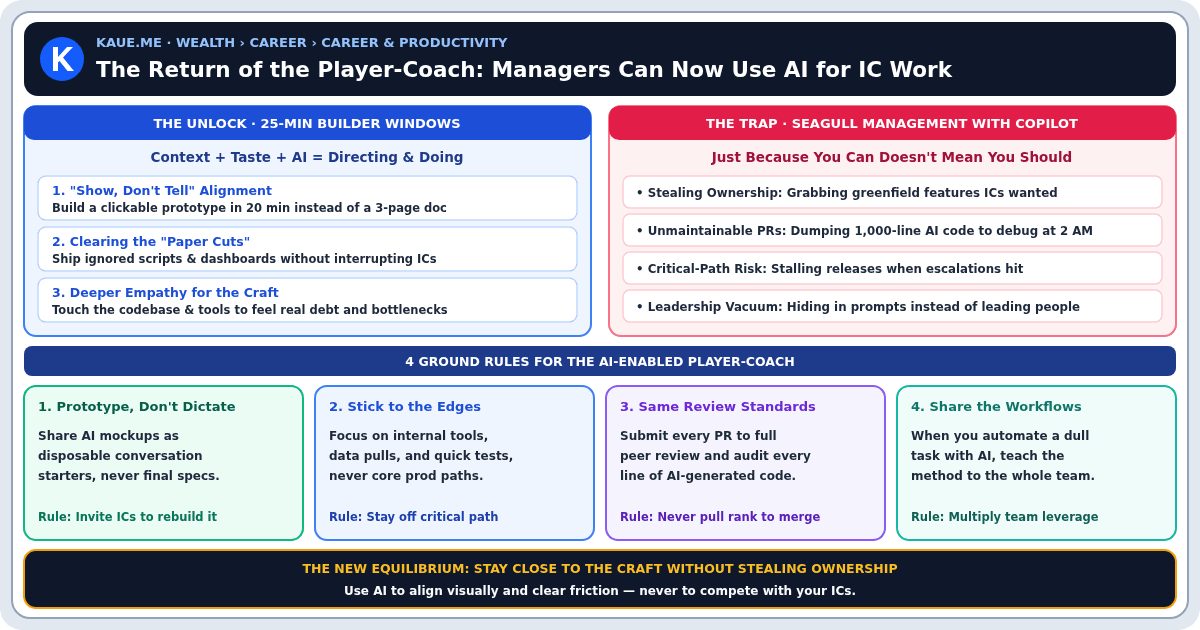
Instead of writing a three-page requirements document and hoping an engineer or designer interprets it correctly, a manager can spend 20 minutes building a rough, clickable prototype with AI. Showing a tangible artifact sparks far better conversations than abstract bullet points. It aligns teams faster and exposes edge cases before anyone writes production code.
Every team has a graveyard of low-priority, high-annoyance tasks—internal dashboards, quick data pulls, small scripts, or exploratory proofs of concept—that never make it to the top of the sprint backlog. Managers can now knock these out on their own without interrupting an IC’s deep work on core roadmap items.
Nothing erodes a manager’s credibility faster than losing touch with the daily friction their team faces. When managers actively use the same AI workflows, touch the codebase, or test the design system, they gain firsthand empathy for technical debt, tooling bottlenecks, and realistic timelines.
While the resurgence of the AI-powered player-coach is a massive productivity unlock, it introduces a new set of failure modes. If handled poorly, a manager doing IC work with AI can actually slow a team down and tank morale.
There is a fine line between helping and swooping in. If a manager uses AI over the weekend to build a feature an IC was excited to architect, it strips the IC of ownership and growth. Individual contributors develop mastery by wrestling with ambiguous problems. If a manager grabs the interesting greenfield prototypes and leaves the team to handle maintenance, resentment will follow quickly.
AI makes generating output effortless; it does not make maintaining that output effortless. Falling into blind copy-paste abdication on the AI Trust Pendulum —prompting your way into a 1,000-line pull request without fully understanding the underlying architecture—isn’t helping. You are creating technical debt that your ICs will have to debug at 2:00 AM.
Even with AI, a manager’s schedule is still unpredictable. Emergencies happen, executive priorities shift, and people need support. If a manager becomes a direct bottleneck on a production release because they took on core IC deliverables, the entire team stalls the moment the manager gets pulled into an afternoon of escalations.
The core mandate of a manager hasn’t changed. Coaching, conflict resolution, career growth, strategic clarity, and building psychological safety are deeply human tasks. If doing IC work with AI becomes a comfortable retreat from the harder, messier work of leading people, the team will feel the vacuum.
| Dimension | The Seagull Manager | The AI Player-Coach |
|---|---|---|
| Work Selection | Grabs exciting greenfield features and critical-path tasks | Clears ignored paper cuts, internal tools, and quick experiments |
| Prototypes & Specs | Drops half-baked AI code and expects the team to ship it | Shares rough prototypes explicitly as disposable conversation starters |
| Code Quality & Review | Pulls rank or bypasses checks to merge unreviewed diffs | Submits to identical review standards and audits every line |
| Delivery & People | Retreats into solo prompting to avoid messy leadership work | Protects team ownership and teaches high-leverage workflows |
To get the upside of hands-on AI work without stepping on toes, managers should adopt four clear boundaries:
We are moving away from the era of the purely administrative manager who only moves boxes on a roadmap. AI gives leaders a rare superpower: the ability to stay close to the metal without abandoning their teams.
The best managers in this new era won’t use AI to replace their ICs or compete with them. They will use it to think faster, communicate more visually, clear away distractions, and become sharper, more empathetic partners to the people building the future.
As AI compresses the distance between directing and building, where is the sharpest line you draw between the work you prototype yourself and the ownership you protect for your team?
Get notified when I publish new essays, book summaries, and practical guides on living well. No spam—unsubscribe anytime.
Get the curated offline edition of Kaue's Way of Life—a practical field guide to optimizing 🍏 Health, 💰 Wealth, ❤️ Love, and 🧘 Meaning.
Challenge yourself to a fast 60-second quiz across 🔢 Math, 🌍 Geography, and 💬 Language—with replays, ghost races, and global leaderboards.
Have a question, perspective, or suggestion? Share your thoughts below. Comments are powered by GitHub Discussions (ad-free and spam-free)—click Sign in with GitHub below to comment or react (creating a free GitHub account takes less than a minute).
Updated on Nov 25, 2026.
DISCLAIMER: The content on this site is for informational and educational purposes only and does not constitute medical, psychological, financial, investment, tax, or legal advice. The ideas, curation, and opinions presented here are my own and do not represent those of my employer. Book, lecture, and article summaries are independent educational commentary and remain the intellectual property of their respective authors. AI tools may be used to assist with editing, formatting, and synthesis; while every effort is made to ensure accuracy, errors may occur. PRIVACY: This site uses no tracking cookies; browser local storage is used solely to remember optional language and playback-speed preferences, and hosting logs on Google Cloud process visitor IP addresses, browser metadata, requested resources, page engagement, and referral sources for aggregate traffic statistics. Third-party services used for optional newsletter subscriptions (Mailchimp), comments (giscus / GitHub Discussions), and media downloads/streaming (GitHub) may process visitor IP addresses and cookies in accordance with their respective privacy policies.