If you walk into any large corporation and ask a Vice President, a Director, a Product Manager, and a Senior Engineer a simple question—“Who here is responsible for translating vague business ideas into actual, working reality?"—you will get the exact same answer from all four of them:
“I am.”
In the quiet frustration of their own minds, almost every knowledge worker sees themselves as the lone bridge between two disconnected worlds.
In traditional Christian symbolism, humanity—and specifically the figure of the mediator—stands at the intersection of Heaven and Earth. Heaven is the realm of pure form, invisible meaning, overarching purpose, and abstract vision. Earth is the realm of matter, friction, concrete reality, and physical execution. Without Earth, Heaven is just an intangible ghost; without Heaven, Earth is just a pile of meaningless dirt. Something has to bind them together.
Inside a modern corporation, everyone secretly believes they are that binding agent (a dynamic closely tied to Beyond the Job Description: Why Your Role Is Bigger Than Your Tasks ).
Why does everyone feel this way? Because of where they are standing.
When you sit at your desk and look up the management hierarchy, all you see is the clouds. Your boss, and your boss’s boss, speak in what feels like maddeningly vague abstractions. They talk about “synergies,” “market positioning,” “Q4 strategic pillars,” and “north stars.” To you, their ideas are weightless. They lack structure, edge cases, and an understanding of how the machinery actually works.
When you look down the hierarchy (or deeper into the technical weeds), all you see is the dirt. You see people fixated on granular, hyper-specific problems—arguing over a button color, a database schema, or a localized workflow—seemingly oblivious to the overarching business goal.
And there you are, standing right on the horizon line. You take the cloudy commands from above and hammer them into actionable plans for the people below. You take the messy realities from below and package them into coherent narratives for the people above.
Naturally, you conclude: I am the only one here connecting Heaven and Earth.
The illusion breaks when you step back and look at the organization not as a two-tier system of “thinkers” and “doers,” but as a continuous gradient of translation.
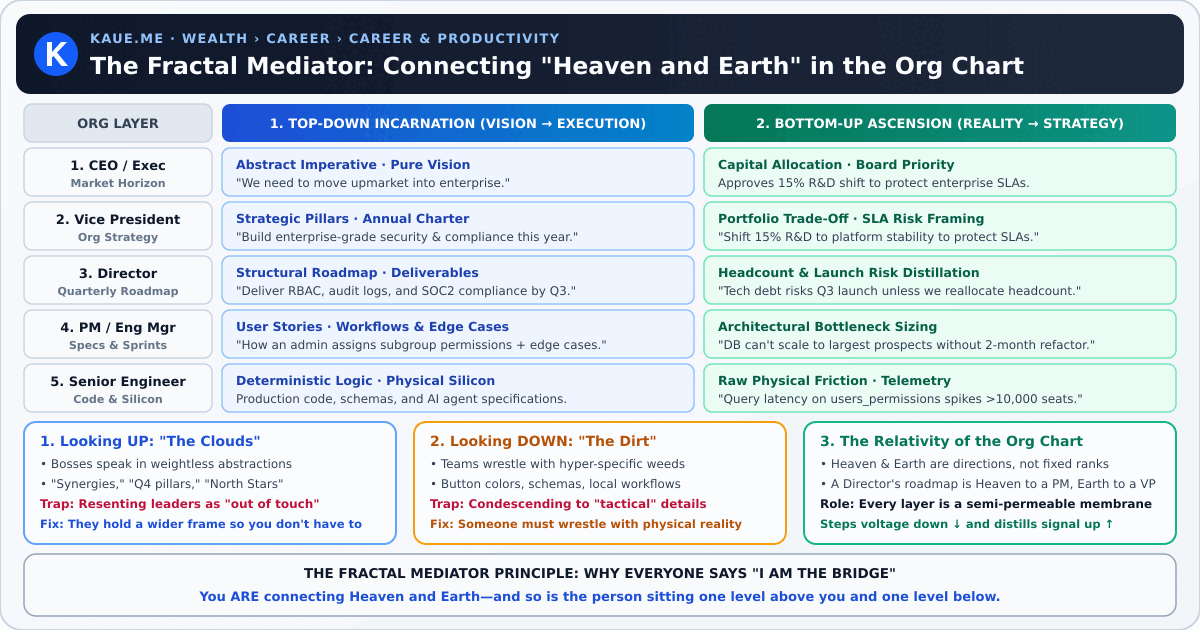
Consider what happens when a high-level business need moves down the hierarchy. In theological terms, this is incarnation—the process of an abstract spirit taking on flesh and bone:
At every single rung of the ladder, the person received something that felt like “Heaven” (an abstract goal) and handed down something that looked like “Earth” (a concrete specification). Nobody did the whole job; everyone stepped the voltage down just enough for the next layer to handle it without catching fire.
Now, watch the exact same mechanism work in reverse when a concrete reality moves up the chain. This is the process of distillation—stripping away the heavy, localized matter until only the strategic meaning remains (the core skill behind Mastering Executive Communication: A Guide to Driving Action ):
users_permissions table spikes whenever a client has more than 10,000 seats.”As the proposal travels upward, each person strips away the soil of implementation details and translates it into the language of higher-order purpose, risk, and value.
The great secret of organizational life is that Heaven and Earth are not fixed places on the org chart; they are directions.
To a Product Manager, a Director’s quarterly roadmap is an abstract piece of Heaven that needs to be grounded into Jira tickets. But to a VP, that very same Director’s roadmap is the gritty, earthly implementation of a high-level board strategy.
We are all fractal mediators. Every role in a healthy company acts as a semi-permeable membrane—absorbing abstract intent from above and precipitating it into action below, while gathering raw reality from below and evaporating it into insight for those above.
When we forget this, organizational rot sets in:
The next time you feel like the lone Atlas holding the sky and the ground together in your company, take a breath. You are connecting Heaven and Earth—and so is the person sitting one level above you, and the person sitting one level below.
Get notified when I publish new essays, book summaries, and practical guides on living well. No spam—unsubscribe anytime.
Get the curated offline edition of Kaue's Way of Life—a practical field guide to optimizing 🍏 Health, 💰 Wealth, ❤️ Love, and 🧘 Meaning.
Have a question, perspective, or suggestion? Share your thoughts below. Comments are powered by GitHub Discussions (ad-free and spam-free)—click Sign in with GitHub below to comment or react (creating a free GitHub account takes less than a minute).
Updated on Nov 11, 2026.
DISCLAIMER: The content on this site is for informational and educational purposes only and does not constitute medical, psychological, financial, investment, tax, or legal advice. The ideas, curation, and opinions presented here are my own and do not represent those of my employer. Book, lecture, and article summaries are independent educational commentary and remain the intellectual property of their respective authors. AI tools may be used to assist with editing, formatting, and synthesis; while every effort is made to ensure accuracy, errors may occur. PRIVACY: This site uses third-party services for optional newsletter subscriptions (Mailchimp), comments (giscus / GitHub Discussions), and embedded media (YouTube), which may process visitor IP addresses and cookies in accordance with their respective privacy policies.