🎨 The Best XKCD Comics About Software Engineering (With Context) 🔗
Randall Munroe’s xkcd (all comic artwork © Randall Munroe, xkcd.com, licensed under Creative Commons Attribution-NonCommercial 2.5 / CC BY-NC 2.5) is practically the unofficial holy text of software engineering, computer science, and data analytics. Beyond the surface-level punchlines lies the heart of the jokes—the shared pain, the late-night debugging sessions, and the inside baseball of the tech industry.
Here is a categorized and fully contextualized selection of the best comics, with explanations of why they actually hit home for developers.
📑 Table of Contents 🔗
💻 1. The Daily Grind (Code & Architecture) 🔗
⚔️ Compiling (XKCD 303) 🔗
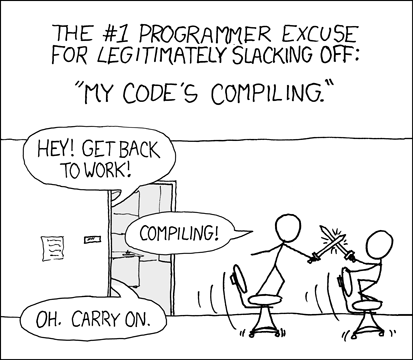
The Joke: Two developers are having a sword fight on office chairs. When their boss yells at them to get back to work, they respond: “My code’s compiling.”
Why it hits home: Before modern blazing-fast build tools, compiling large software projects could take hours. “Compiling” became the ultimate get-out-of-jail-free card for developers to slack off, browse the internet, or chat with coworkers. It perfectly captures the downtime built into a programmer’s day.
🔁 Fixing Problems (XKCD 1739) 🔗
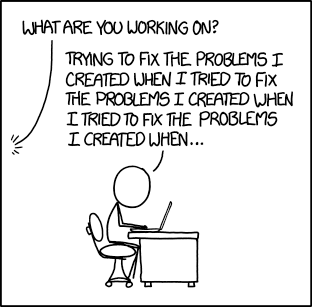
The Joke: A programmer is asked what they are working on, and they reply: “Trying to fix the problems I created when I tried to fix the problems I created when I tried to fix the problems I created when…”
Why it hits home: Colloquially known as “yak shaving,” this is the infinite recursion of software engineering. You set out to fix a small bug, which requires updating a dependency, which breaks your environment, which requires tweaking your OS, until you’ve completely forgotten what you originally set out to do.
🔌 Standards (XKCD 927) 🔗
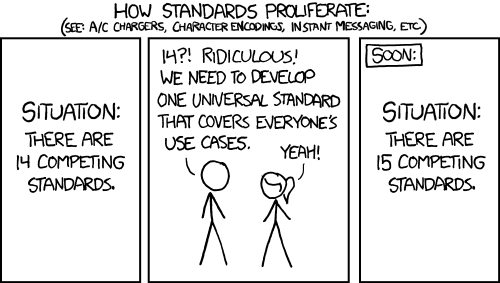
The Joke: “Situation: There are 14 competing standards.” A developer decides to build one universal standard that covers everyone’s use cases. “Situation: There are 15 competing standards.”
Why it hits home: This is the story of every JavaScript framework, USB cable, and messaging app in existence. In tech, attempts to unify fragmented systems almost always result in just adding one more fragment to the pile.
🎲 Random Number (XKCD 221) 🔗
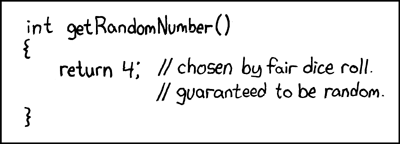
The Joke: A function named getRandomNumber() simply contains the code: return 4; // chosen by fair dice roll. guaranteed to be random.
Why it hits home: It mocks how developers often mock up or “stub” complex logic with hardcoded values, completely undermining the purpose of the function. It’s a hilarious critique of bad testing practices and broken random number generators.
🔐 2. Security & Database Nightmares 🔗
🗃️ Exploits of a Mom (XKCD 327) 🔗
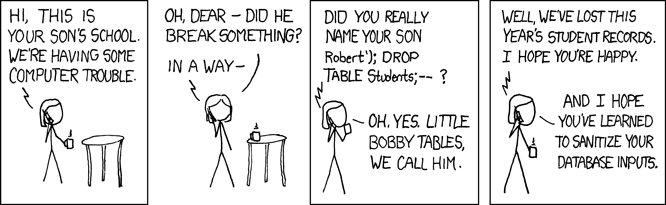
The Joke: A school calls a mother to ask if she really named her son Robert'); DROP TABLE Students;--. She says yes, and calls him “Little Bobby Tables.” The school complains that they lost this year’s student records. Her response? “I hope you’ve learned to sanitize your database inputs.”
Why it hits home: This is the most famous explanation of an SQL Injection vulnerability ever created. It reminds every backend engineer of the catastrophic consequences of trusting user input blindly.
🐎 Password Strength (XKCD 936) 🔗
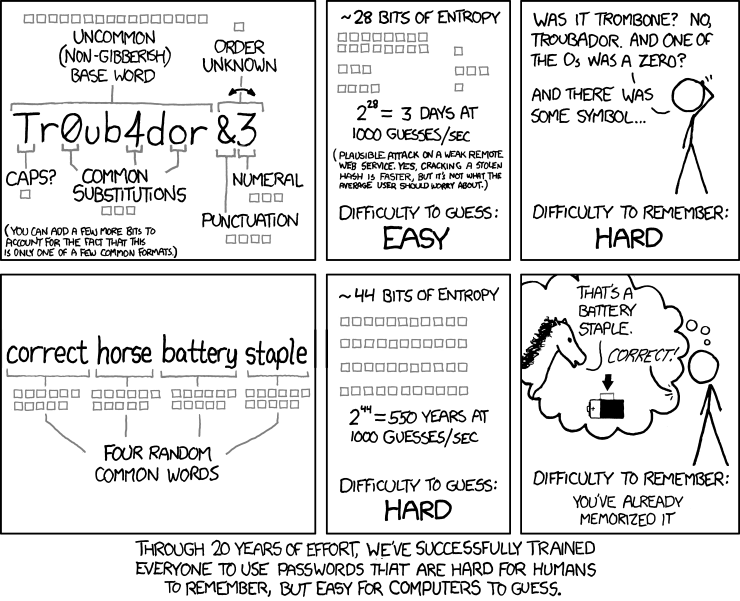
The Joke: It compares a traditional “strong” password (like Tr0ub4dor&3, which is hard for humans to remember but easy for computers to guess) with four random common words (correct horse battery staple, which is easy for humans to remember but mathematically harder for computers to crack).
Why it hits home: It completely redefined how developers and the public think about password entropy. It highlighted the absurdity of corporate password requirements that force users into bad security habits.
🥪 Sandwich (XKCD 149) 🔗
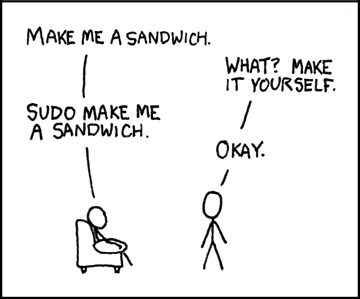
The Joke: “Make me a sandwich.” / “What? Make it yourself.” / “sudo make me a sandwich.” / “Okay.”
Why it hits home: In Unix/Linux systems, sudo (Superuser DO) forces the operating system to execute a command with maximum administrative privileges. It’s the ultimate sysadmin power move, jokingly applied to real life.
📊 3. Math, Data & Logic 🔗
📈 Correlation (XKCD 552) 🔗
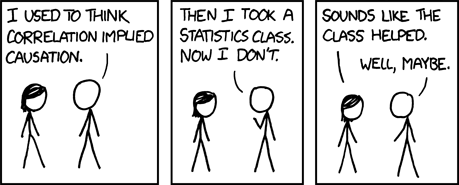
The Joke: “I used to think correlation implied causation. Then I took a statistics class. Now I don’t.” / “Sounds like the class helped.” / “Well, maybe.”
Why it hits home: Data scientists spend half their careers explaining to management that just because two metrics are trending upward together doesn’t mean one is causing the other.
✋ Base Rate (XKCD 2476) 🔗
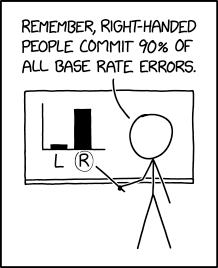
The Joke: A presenter shows a bar chart where the “Right” bar is massively higher than the “Left” bar, stating: “Remember, right-handed people commit 90% of all base rate errors.”
Why it hits home: The base rate fallacy occurs when people ignore general population statistics in favor of specific info. Since roughly 90% of all people are right-handed, of course they commit 90% of the errors. It’s a brilliant jab at misleading data visualization.
🧠 Logical (XKCD 1901) 🔗
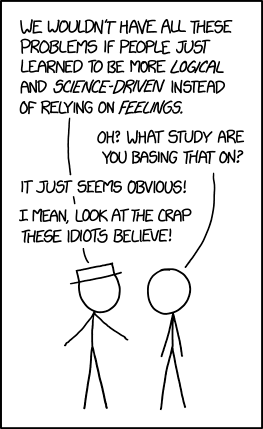
The Joke: A character complains that the world would be better if everyone was just “logical and science-driven.” When asked for a study backing that up, they get defensive and say, “It just seems obvious!”
Why it hits home: A sharp critique of the “tech bro” mentality where engineers assume they can solve complex social or humanities problems purely through “logic,” while being completely blind to their own unscientific biases.
🗺️ Travelling Salesman Problem (XKCD 399) 🔗
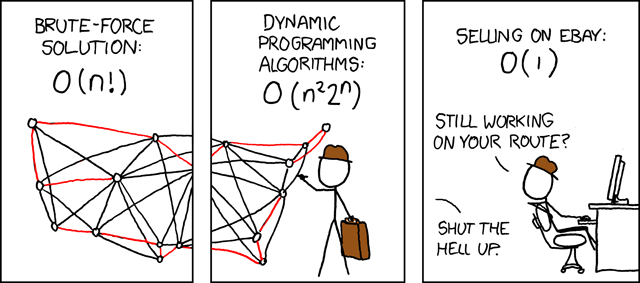
The Joke: Compares route optimization algorithms. Brute-force: . Dynamic programming: . The final panel shows the true optimal solution: “Selling on eBay: ”.
Why it hits home: The Travelling Salesman Problem is notoriously difficult to compute for large datasets. The comic reminds engineers that sometimes the best solution to a complex algorithmic problem isn’t writing better code—it’s changing the business model entirely.
♾️ e to the pi times i (XKCD 179) 🔗
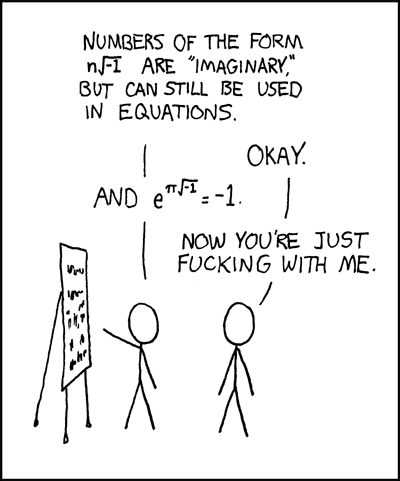
The Joke: One character explains imaginary numbers to another, concluding with Euler’s identity: . The other responds: “Now you’re just messing with me.”
Why it hits home: Euler’s identity is considered the most beautiful equation in mathematics because it links five fundamental constants () in an entirely unintuitive way. It captures the sheer bewilderment most people feel when they first study advanced discrete math or physics.
🧬 4. The Developer’s Brain (Language, Life & Biology) 🔗
🎯 Nerd Sniping (XKCD 356) 🔗
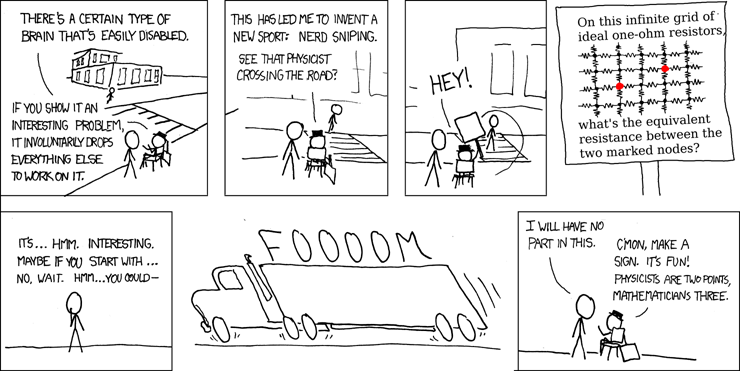
The Joke: A physicist is walking across a street. Someone holds up a sign with a complex resistor grid problem. The physicist stops dead in their tracks to solve it, completely oblivious to the oncoming truck.
Why it hits home: “Nerd sniping” has become an actual industry term for presenting engineers with a problem so incredibly interesting that they drop all their actual, productive work to solve it.
🧬 DNA (XKCD 1605) 🔗
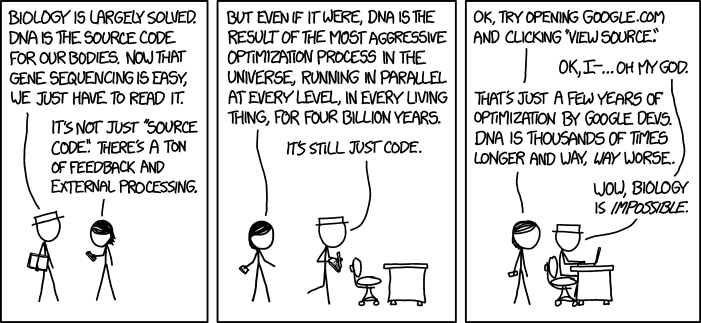
The Joke: A naive tech guy says DNA is just the “source code” for our bodies and should be easy to read. A biologist shows him the convoluted, minified, hyper-optimized frontend source code for a website and says, “DNA is thousands of times longer and way, way worse.”
Why it hits home: Programmers love to compare biology to computers, but the comic ruthlessly points out that DNA wasn’t written by a clean-code architect—it evolved over billions of years of trial, error, and messy legacy spaghetti code.
🗣️ Language Nerd (XKCD 1443) 🔗
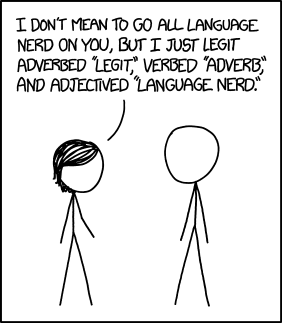
The Joke: “I don’t mean to go all language nerd on you, but I just legit adverbed ’legit,’ verbed ‘adverb,’ and adjectived ’language nerd’.”
Why it hits home: Developers spend their lives parsing the rigid syntax of programming languages. When they switch to natural human language, they love stretching the rules of grammar and syntax to their absolute breaking point just to see if it still compiles in a human brain.
🌿 Garden Path Sentence (XKCD 2793) 🔗
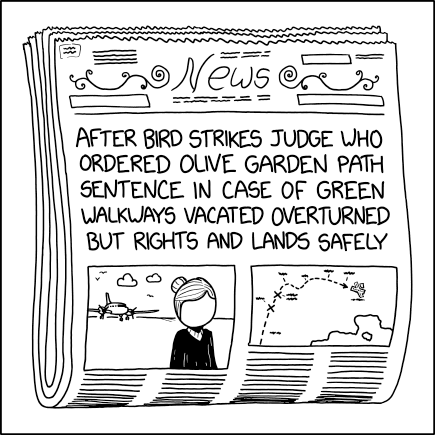
The Joke: A newspaper headline reads: “After bird strikes judge who ordered olive garden path sentence in case of green walkways vacated overturned but rights and lands safely.”
Why it hits home: A “garden-path sentence” forces the reader’s brain to parse the grammar incorrectly on the first pass, requiring them to go back and re-read it. For engineers who spend hours writing string parsers and Regular Expressions (Regex), seeing the human brain fail a parsing task is highly relatable.
🎓 Students (XKCD 557) 🔗
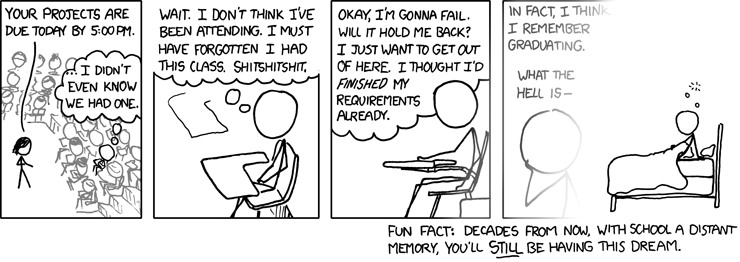
The Joke: A student realizes they have a project due at 5:00 PM for a class they forgot they were enrolled in, terrified it will hold back their graduation. They suddenly realize they graduated years ago. The caption: “Decades from now, with school a distant memory, you’ll still be having this dream.”
Why it hits home: Imposter syndrome and academic anxiety never truly leave you. Almost every highly educated professional in STEM occasionally wakes up in a cold sweat thinking they missed a final exam for a degree they already have hanging on their wall.
