In computer science, a real-time system is one where the correctness of an operation depends not only on its logical result, but also on the exact time at which that result is delivered. Think of the anti-lock braking controller in a car or the fly-by-wire computer on an airliner. If the processor calculates the exact right adjustment, yet delivers that calculation 50 milliseconds past its deadline, the output isn’t merely delayed—it is wrong. Sometimes catastrophically so.
Human schedules run on remarkably similar physics. Yet most of us treat our daily appointments as if time were symmetric—as if arriving five minutes late and arriving five minutes early were equally minor misses on either side of a bullseye.
They aren’t. In everyday life, just as in systems engineering, the cost function of time is sharply asymmetric: a gentle valley on one side of the clock, and a sheer cliff on the other.
In a hard real-time system, missing a deadline triggers a total failure—the gate closes, the train pulls away from the platform, or the courtroom doors lock. In a firm or soft real-time system—a team standup, a job interview, or dinner with a close friend—the world doesn’t end, but the value of your presence drops steeply the moment the clock crosses the start time.
When you operate on the wrong side of a deadline, the penalty isn’t linear; it compounds across two fronts at once:
By the time you sit down ten minutes past the hour, you aren’t just behind the clock—you are starting from a deficit of goodwill and mental clarity.
To avoid that cliff, conscientious, optimization-minded people often aim for exact punctuality. If a map app says a drive takes 20 minutes, they step out the front door with 20 minutes to spare.
On paper, aiming for zero offset looks like peak efficiency: you waste zero minutes of your own day sitting in a lobby, and you keep nobody else waiting.
In practice, aiming to be “right on time” is high-stress, brittle engineering.
In computing, real-world networks and processors suffer from jitter—unpredictable spikes in latency caused by packet contention, background tasks, or hardware bottlenecks. Physical and digital life is full of jitter:
When you design your schedule around average-case travel time, you leave yourself zero slack time—ignoring the Margin of Safety mental model that structural engineers build into every bridge and aircraft wing. Any routine burst of jitter shoves you straight over the cliff into “late” territory. And even when luck holds and you burst through the door as the clock strikes the hour, you arrive out of breath, heart rate elevated, and mentally scattered. You met the deadline, yet your nervous system is redlining.
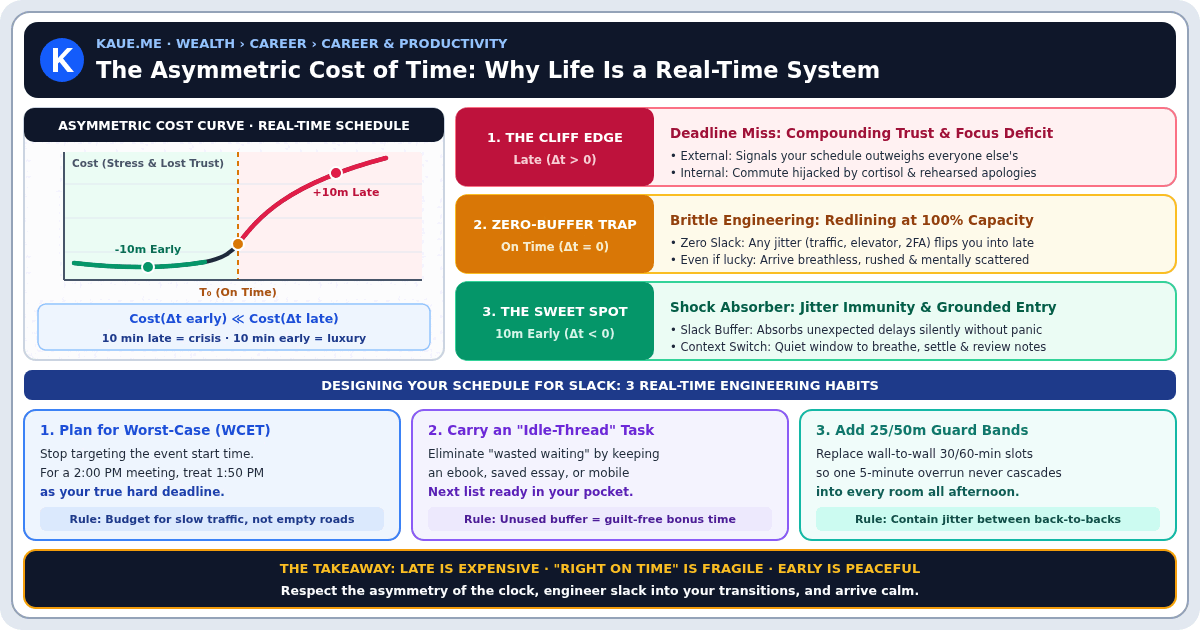
Plot the real cost of an arrival—stress, reputation damage, lost focus, and missed opportunities—against your arrival offset relative to the start time, and you don’t get a symmetric V-shaped curve. You get a flat, calm valley on the left and a vertical wall on the right:
Being ten minutes late is a mini-crisis. Being ten minutes early is a luxury.
| Arrival Zone | Target Offset | System State | When Jitter Hits | Net Effect |
|---|---|---|---|---|
| The Cliff Edge | Late () | Deadline miss | Cascades into deeper lateness | Eroded trust, rushed apologies, scattered focus |
| The Zero-Buffer Trap | “Right on Time” () | Redlining at 100% | Flips immediately into late | Elevated heart rate, zero margin for error |
| The Sweet Spot | 10 Minutes Early () | Buffered with slack | Absorbed silently by buffer | Calm entry, prepared mind, compounding reliability |
Intentionally shifting your target arrival to ten minutes before the start time installs a shock absorber right into your calendar:
In a well-engineered real-time operating system, critical tasks are never scheduled around best-case speed; they are scheduled around Worst-Case Execution Time (WCET) so every job finishes comfortably before its hard deadline.
When you put on your planner’s hat—separating calm schedule design from real-time execution, as in Don’t Let Your Mood Vote on Your Schedule —apply the same three rules to your calendar:
Late is expensive. “Right on time” is fragile. Early is peaceful.
Once you stop pretending that five minutes early and five minutes late cost the same, punctuality stops being a daily test of willpower and becomes a simple systems-design choice. Respect the asymmetry of the clock, engineer slack into your transitions, and give yourself the quiet advantage of arriving relaxed.
Get notified when I publish new essays, book summaries, and practical guides on living well. No spam—unsubscribe anytime.
Get the curated offline edition of Kaue's Way of Life—a practical field guide to optimizing 🍏 Health, 💰 Wealth, ❤️ Love, and 🧘 Meaning.
Challenge yourself to a fast 60-second quiz across 🔢 Math, 🌍 Geography, and 💬 Language—with replays, ghost races, and global leaderboards.
Have a question, perspective, or suggestion? Share your thoughts below. Comments are powered by GitHub Discussions (ad-free and spam-free)—click Sign in with GitHub below to comment or react (creating a free GitHub account takes less than a minute).
Updated on Nov 19, 2026.
DISCLAIMER: The content on this site is for informational and educational purposes only and does not constitute medical, psychological, financial, investment, tax, or legal advice. The ideas, curation, and opinions presented here are my own and do not represent those of my employer. Book, lecture, and article summaries are independent educational commentary and remain the intellectual property of their respective authors. AI tools may be used to assist with editing, formatting, and synthesis; while every effort is made to ensure accuracy, errors may occur. PRIVACY: This site uses no tracking cookies; browser local storage is used solely to remember optional language and playback-speed preferences, and hosting logs on Google Cloud process visitor IP addresses, browser metadata, requested resources, page engagement, and referral sources for aggregate traffic statistics. Third-party services used for optional newsletter subscriptions (Mailchimp), comments (giscus / GitHub Discussions), and media downloads/streaming (GitHub) may process visitor IP addresses and cookies in accordance with their respective privacy policies.