When you first start integrating AI into your daily workflow, you probably think you are learning a technical skill. You read up on prompt engineering, context windows, and model capabilities.
Before long, however, you realize that working effectively with AI isn’t really a technical challenge at all—it is a management challenge (the exact shift explored in Coding with AI: Why Every Developer Is Becoming an Engineering Manager ).
Watch anyone adopt AI over a few months, and you will see them swing through the exact same psychological arc that every new manager goes through when they get their first direct reports. It is a pendulum that swings from paranoid micromanagement to reckless abdication, before finally settling into calibrated delegation.
When you first hand a task over to an AI—whether it is summarizing a report, drafting an email, or writing a block of code—your guard is all the way up. You know these models can hallucinate. You have seen the weird screenshots on social media.
So, you treat the AI like an untrustworthy intern on their very first day.
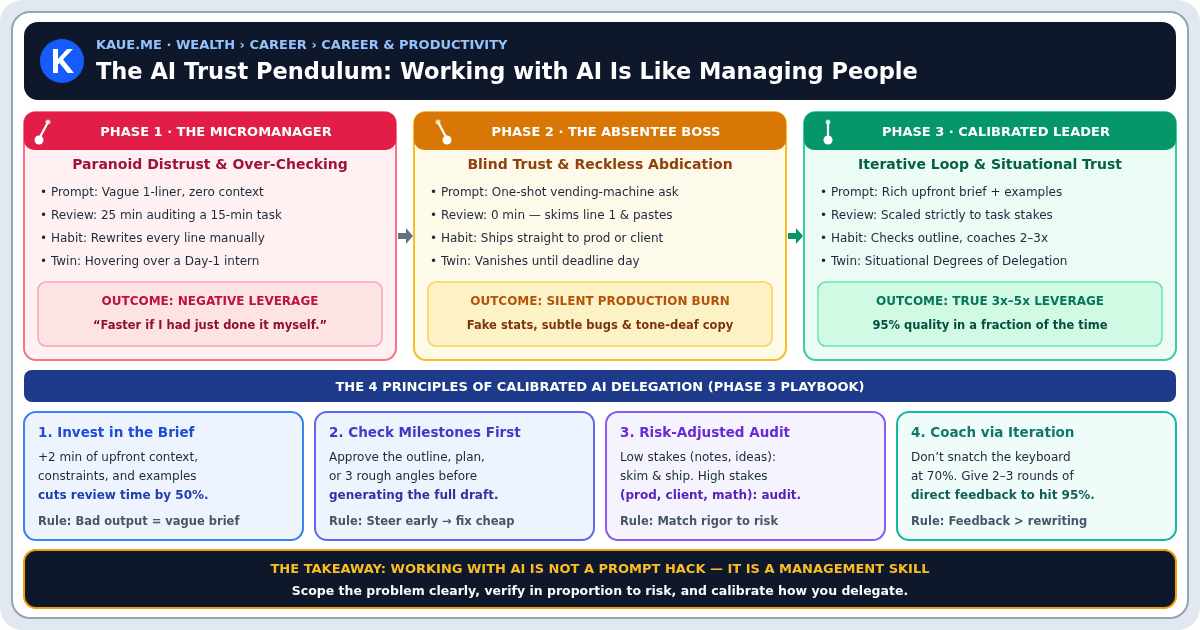
You ask it to do a 15-minute task, and then you spend 25 minutes scrutinizing every single word, cross-referencing every claim, and practically rewriting the whole thing from scratch because it didn’t phrase things quite the way you would have. At this stage, working with AI feels exhausting. You walk away thinking, “Honestly, it would have been faster if I had just done it myself.”
The Management Analogy: This is classic micromanagement. Every new manager falls into the trap of believing that nobody can do the job as well as they can. By hovering over a direct report’s shoulder and nitpicking their process, you destroy the 3x to 5x return on leverage that delegation is supposed to give you—turning a potential time-saver into a bottleneck.
Eventually, the AI surprises you. It nails a complex coding problem in seconds, or it drafts a project proposal that is 95% ready to go. Then it does it again. And again.
Suddenly, the pendulum swings aggressively to the other side. Your skepticism evaporates and is replaced by a seductive sense of relief. You stop reading the outputs carefully. You skim the first sentence, assume the rest is solid, and copy-paste the result straight into a client deck, a codebase, or a team chat channel.
And that is when you get burned.
Maybe it is a fabricated statistic buried in paragraph four, a subtle hallucination or logic bug that breaks production , or a tone-deaf phrase that makes it painfully obvious you didn’t read what you just sent.
The Management Analogy: In leadership, this is when “delegation” quietly turns into “abdication.” A direct report delivers a few wins, so the manager stops checking in altogether. They hand off a massive, ambiguous project with zero oversight, only to discover on the day of the deadline that the employee misunderstood a core constraint three weeks ago. Trust without verification isn’t empowerment—it is negligence.
| Dimension | Phase 1: The Micromanager | Phase 2: The Absentee Boss | Phase 3: The Calibrated Leader |
|---|---|---|---|
| Default Stance | Paranoid distrust | Blind relief & abdication | Calibrated, task-specific trust |
| Prompting Habit | Vague prompt, heavy manual rewrite | One-shot prompt, instant copy-paste | Rich upfront brief + milestone loop |
| Review Cost | 25 minutes auditing a 15-minute task | 0 minutes—until an embarrassing failure | Scaled strictly to task risk & stakes |
| Leadership Twin | Hovering over every keystroke | Vanishing until deadline day | Situational Degrees of Delegation |
Getting burned in Phase 2 is actually a rite of passage. Instead of sending you back to Phase 1, it usually pushes you toward the middle: calibrated trust.
You realize that AI isn’t an infallible oracle, nor is it a useless toy. It is a capable, fast, slightly literal-minded junior partner. To get the best results without wasting all your time checking its work, you stop treating AI like a vending machine where you put in one prompt and expect a finished product. Instead, you treat it like a collaborative loop.
This is where the management concept of Degrees of Delegation comes into play. Great managers don’t use a single style of oversight for every person and every task; they adjust their involvement based on the stakes and the capabilities of the person doing the work.
When you apply this framework to AI, your workflow transforms:
If a direct report gives you bad work, the first question a good manager asks is, “Did I set clear expectations?” If you give an AI a lazy, one-sentence prompt and have to spend 20 minutes fixing the output, that is a management failure. Spend an extra two minutes upfront providing context, constraints, and examples, and you will cut your review time in half.
When delegating a big project to a teammate, you don’t wait until they have written a 20-page document to tell them their structure is wrong. You check the outline first. Do the same with AI. Ask it to generate an outline, an architectural plan, or three rough angles before telling it to write the full piece. Steering early is cheap; fixing late is expensive.
You don’t need to verify everything with the same intensity:
When a report brings you a draft that is 70% there, you don’t snatch the keyboard out of their hands and finish it yourself. You say, “Good start—now tighten up the second section and make the tone more direct.” Giving yourself permission to go back and forth with the AI two or three times gets you to a 95% solution in a fraction of the time it would take to manually edit a mediocre first draft.
The people getting the most value out of AI right now aren’t necessarily the ones with the deepest technical backgrounds. They are the ones who understand how to scope a problem, communicate context clearly, spot-check strategically, and give actionable feedback.
If you feel like you are spending too much time double-checking AI—or if you have recently been embarrassed because you didn’t check it enough—step back and put your manager hat on. You don’t need a better prompt hack. You just need to calibrate how you delegate.
Get notified when I publish new essays, book summaries, and practical guides on living well. No spam—unsubscribe anytime.
Get the curated offline edition of Kaue's Way of Life—a practical field guide to optimizing 🍏 Health, 💰 Wealth, ❤️ Love, and 🧘 Meaning.
Have a question, perspective, or suggestion? Share your thoughts below. Comments are powered by GitHub Discussions (ad-free and spam-free)—click Sign in with GitHub below to comment or react (creating a free GitHub account takes less than a minute).
Updated on Nov 17, 2026.
DISCLAIMER: The content on this site is for informational and educational purposes only and does not constitute medical, psychological, financial, investment, tax, or legal advice. The ideas, curation, and opinions presented here are my own and do not represent those of my employer. Book, lecture, and article summaries are independent educational commentary and remain the intellectual property of their respective authors. AI tools may be used to assist with editing, formatting, and synthesis; while every effort is made to ensure accuracy, errors may occur. PRIVACY: This site uses third-party services for optional newsletter subscriptions (Mailchimp), comments (giscus / GitHub Discussions), and embedded media (YouTube), which may process visitor IP addresses and cookies in accordance with their respective privacy policies.