🧩 Cracking the IQ Test: 18 Questions, Answers, and Explanations 🔗
Cognitive aptitude assessments do not measure memorized trivia; they evaluate fluid reasoning—how quickly and accurately you identify underlying rules across verbal, numerical, spatial, and deductive problems.
Below is an original analytical walkthrough of 18 representative cognitive puzzles across five core reasoning domains, complete with step-by-step derivations of the underlying logic.
📑 Table of Contents 🔗
🧠 Verbal Classification (Odd One Out) 🔗
👃 1. Sensory Input vs. Motor Action 🔗
Prompt: Which concept does not belong in the group: Smelling, Seeing, Smiling, or Hearing?
Answer: Smiling
Explanation: Smelling, seeing, and hearing are afferent sensory modalities (ways the nervous system receives external information), whereas smiling is an efferent motor expression.
🌸 2. Human Artifact vs. Natural Organism 🔗
Prompt: Which item does not belong in the group: Painting, Poem, Flower, or Song?
Answer: Flower
Explanation: A painting, a poem, and a song are all intentional artistic creations produced by humans; a flower is a biological organism that grows in nature.
🗓️ Temporal & Chiral Reasoning 🔗
📅 3. Relative Day Indexing 🔗
Prompt: If Monday is two days from today, what day of the week was yesterday?
- Wednesday
- Friday
- Saturday
- Sunday
Answer: Friday
Explanation: Anchor “today” as day :
- Day is Monday, so day (tomorrow) is Sunday, and day (today) is Saturday.
- Moving back one day () makes yesterday Friday.
🧤 7. Spatial Chirality (3D Reflection) 🔗
Prompt: True or False: Inverting a left-handed glove inside out allows it to fit a right hand.
- True
- False
Answer: True
Explanation: Human hands are chiral (3D mirror images that cannot be superimposed by rotation alone). Turning a left-handed glove inside out performs a spatial reflection across a plane, reversing its chirality so the thumb and palm orientation match a right hand.
🔗 Proportional Analogies 🔗
☕ 4. Containment Relationship 🔗
Prompt: Coffee relates to cup in the same way that cake relates to:
- Fork
- Napkin
- Plate
Answer: Plate
Explanation: The relation is consumable item : primary vessel that holds it. Liquid coffee is served in a cup; solid cake is served on a plate.
🍃 5. Direct Structural Attachment 🔗
Prompt: Finger relates to hand in the same way that leaf relates to:
- Twig
- Tree
- Forest
Answer: Twig
Explanation: Avoid jumping to the largest whole (tree or forest). The relationship is terminal part : immediate supporting structure. Just as a finger attaches directly to a hand (which attaches to an arm), a leaf attaches directly to a twig (which attaches to a branch).
(Hierarchy: )
🧮 Numerical Reasoning & Sequences 🔗
➗ 6. Compound Fractions 🔗
Prompt: What is one-half of one-quarter of 400?
- 50
- 100
- 200
Answer: 50
Explanation: One-quarter of 400 is , and half of 100 is 50:
📈 14. Arithmetic Second-Order Differences 🔗
Prompt: Find the next term in the progression: 1, 2, 4, 7, 11, 16, 22, ?
Answer: 29
Explanation: The first differences between consecutive terms form a linearly increasing sequence ():
✖️ 15. Alternating Operations 🔗
Prompt: Find the next term in the progression: 3, 6, 10, 20, 24, ?
Answer: 48
Explanation: The rule alternates between doubling () and adding four ():
🔀 16. Interleaved Subsequences 🔗
Prompt: Find the next term in the progression: 8, 6, 9, 5, 10, 4, 11, ?
Answer: 3
Explanation: Separate the sequence into odd-indexed and even-indexed positions:
- Odd positions (1st, 3rd, 5th, 7th): (increments by )
- Even positions (2nd, 4th, 6th, 8th): (decrements by )
Since the missing 8th term belongs to the even-indexed subsequence, .
👁️ Visual & Spatial Matrix Reasoning 🔗
🔄 8. Incremental Angular Rotation 🔗
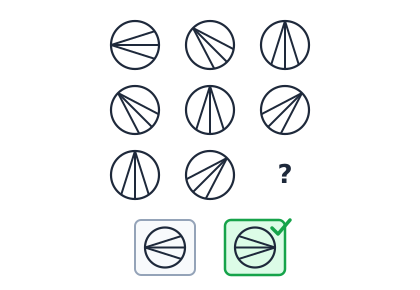
Answer: The right-hand option (arrow pointing directly right).
Explanation: Reading across each row from left to right, the figure rotates clockwise by per step. Rotating the bottom-middle arrow ( up-and-right) by another clockwise points it horizontally to the right.
➕ 9. Shape Superposition (Set Union) 🔗
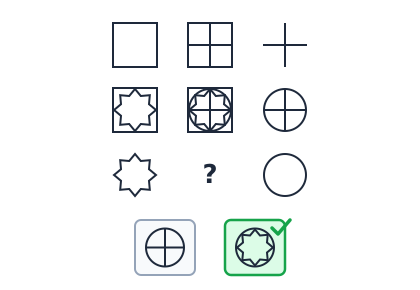
Answer: The right-hand option (polygon inscribed inside a circle).
Explanation: Within each row, the middle cell represents the visual superposition (union) of the outer left and outer right cells. Because the middle cell contains both the circle and the inner polygon while the first cell contains only the outer frame, the third cell must supply the combined inner polygon and circle.
⬠ 10. Polygon Vertex Count 🔗

Answer: The first figure on the left.
Explanation: Count the edges/vertices: the first shape is a pentagon (5 sides), whereas the remaining four shapes are all irregular hexagons (6 sides).
📐 11. Convexity vs. Concavity 🔗

Answer: The second figure from the left.
Explanation: All other figures are convex polygons (every interior angle is strictly less than ). The second figure has an inward-pointing dent (an interior reflex angle greater than ), making it a concave polygon.
🪞 12. 2D Rotation vs. Reflection 🔗

Answer: The second figure from the left.
Explanation: Four of the five figures are rigid 2D rotations of the exact same asymmetric shape in the plane. The second figure has been mirrored (reflected), so no in-plane rotation can align it with the others.
🧩 13. Edge-Continuity Pattern Completion 🔗
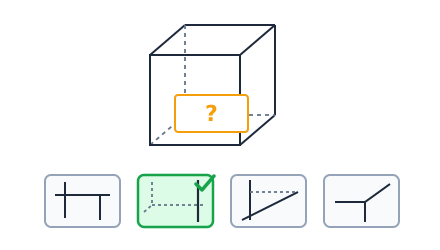
Answer: The second candidate tile (featuring a continuous vertical line along its right border and a bottom-left corner vertex).
Explanation: Tracing the boundary lines of the surrounding grid shows that the missing quadrant requires a full vertical segment along its right edge to close the adjacent shape, which uniquely selects the second tile.
⚖️ Formal Deductive Logic (Categorical Syllogisms) 🔗
💍 17. Existential Intersection (Some A are B + All A are C)
🔗
Premises:
- Some bracelets are valuable jewelry.
- All bracelets are made of gold.
Which conclusion follows with logical certainty?
- Some bracelets are made of silver.
- Some valuable jewelry is made of gold.
Answer: Some valuable jewelry is made of gold.
Explanation: Let = bracelets, = valuable jewelry, and = gold items. Premise 1 guarantees . Premise 2 states . Therefore, the non-empty intersection is necessarily a subset of , proving (some valuable jewelry is made of gold).

🏛️ 18. Disjoint Set Exclusion (Some A are B + No B is C)
🔗
Premises:
- Some politicians are lazy.
- No lazy person is wealthy.
Which conclusion follows with logical certainty?
- Some politicians are not wealthy.
- Some politicians are wealthy.
Answer: Some politicians are not wealthy.
Explanation: Let = politicians, = lazy people, and = wealthy people. Premise 1 guarantees . Premise 2 states . Any member of is in and cannot be in , which guarantees that some politicians are not wealthy (while leaving open whether other politicians outside might or might not be wealthy).