If you have spent any significant time integrating AI into your daily software development workflow, you have probably noticed a subtle shift in how your brain feels at the end of the day. You are writing less boilerplate, typing fewer characters, and spending far less time hunting through documentation for exact syntax. Yet you are still exhausted—just in a completely different way.
That is because adopting AI as a software engineer isn’t just like getting a faster autocomplete. Using AI is like transferring from a Software Engineering Individual Contributor (IC) to an Engineering Manager.
When you make this leap, your day-to-day leverage shifts entirely from execution to specification and review.
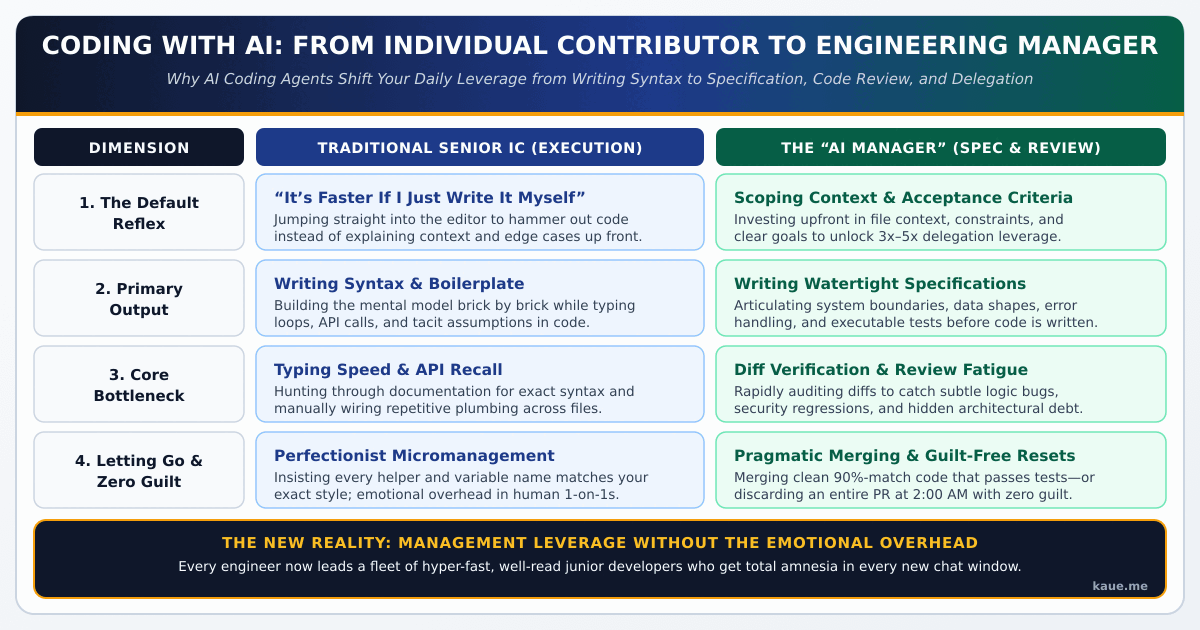
Ask any new engineering manager what their hardest habit to break was, and they will almost universally tell you the same thing: looking at a task and thinking, “It would be so much faster if I just wrote this myself.”
Working with AI triggers the exact same reflex.
When you are deep in a codebase, translating the mental model in your head into a detailed prompt—gathering the right file contexts, explaining architectural constraints, and defining edge cases—can feel like way more friction than just opening an editor and hammering out the code.
Just like a new manager has to learn how to delegate effectively to scale their output, an AI-augmented engineer has to learn how to scope a task and provide clear acceptance criteria before seeing the 3x to 5x return on leverage .
Once you get past the initial friction of delegation, you quickly realize that the mental muscles required to get great output from an LLM are practically identical to those used in engineering management.
In traditional management, vague Jira tickets produce buggy, misaligned features from human engineers. In AI development, vague prompts produce hallucinated spaghetti code.
To succeed, you are forced to articulate the tacit knowledge sitting in the back of your head before a single line of code gets generated. You have to clearly define system boundaries, data shapes, error-handling expectations, and executable test specifications up front. You are no longer paid primarily for knowing how to write a loop; you are paid for knowing how to write a watertight specification.
When you write code yourself, you build the mental model brick by brick as you type. When you manage—or prompt—someone else builds it, and you have to verify it.
Your primary bottleneck is no longer typing speed or memorizing library APIs. Instead, your bottleneck is your ability to rapidly read a diff, spot subtle logic bugs, catch security regressions, and verify that the proposed solution actually fits into the broader architecture without introducing hidden technical debt. Review fatigue becomes a very real part of the job.
Micromanagers burn out their teams and themselves by insisting that every line of code look exactly the way they would have written it. Great managers learn to accept code that is ninety percent how they would have approached it, provided it is readable, maintainable, and passes all the tests.
With AI, you face this micro-decision dozens of times a day. Do you spend another ten minutes tweaking your prompt to get the variable naming and helper functions structured just to your personal taste, or do you recognize that the logic is sound, merge it, and move on to the next problem?
Of course, there is one massive difference between managing humans and managing models: AI gives you the leverage of management without the emotional overhead.
When you are managing an AI workflow:
Ultimately, working with modern AI feels less like managing a traditional org chart and more like managing a fleet of hyper-fast, extraordinarily well-read junior developers who happen to get total amnesia every time you open a new chat window.
As the tools continue to improve, the gap between “senior IC” and “architectural director” is shrinking. Every engineer now sits at the helm of their own miniature development team.
As you navigate this shift in your own workflow, which part of the transition are you feeling the most right now: the immense relief of finally offloading the boilerplate, or the mental fatigue of constantly reviewing code you didn’t write?
Get notified when I publish new essays, book summaries, and practical guides on living well. No spam—unsubscribe anytime.
Get the curated offline edition of Kaue's Way of Life—a practical field guide to optimizing 🍏 Health, 💰 Wealth, ❤️ Love, and 🧘 Meaning.
Have a question, perspective, or suggestion? Share your thoughts below. Comments are powered by GitHub Discussions (ad-free and spam-free)—click Sign in with GitHub below to comment or react (creating a free GitHub account takes less than a minute).
Updated on Nov 4, 2026.
DISCLAIMER: The content on this site is for informational and educational purposes only and does not constitute medical, psychological, financial, investment, tax, or legal advice. The ideas, curation, and opinions presented here are my own and do not represent those of my employer. Book, lecture, and article summaries are independent educational commentary and remain the intellectual property of their respective authors. AI tools may be used to assist with editing, formatting, and synthesis; while every effort is made to ensure accuracy, errors may occur. PRIVACY: This site uses third-party services for optional newsletter subscriptions (follow.it), comments (giscus / GitHub Discussions), and embedded media (YouTube), which may process visitor IP addresses and cookies in accordance with their respective privacy policies.