We usually talk about morality as if we are living in a courtroom or a military barracks. In our everyday vocabulary, temptation is an easy, downhill slide toward selfishness, while goodness is an uphill climb of discipline, rules, and gritted teeth. To be good, we are told, we must override our desires through sheer willpower.
But what happens when we flip that vocabulary on its head? What does it mean to be tempted towards the good?
In Bertolt Brecht’s play The Caucasian Chalk Circle, the servant girl Grusha hesitates over saving an abandoned royal baby at tremendous risk to her own life. Watching her struggle against her own common sense, the narrator remarks: “Terrible is the seductive power of goodness!” In a harsh, cynical world where self-preservation is the sensible rule, kindness sneaks up on us like an irresistible, slightly dangerous impulse. For a guarded cynic, choosing to trust or help feels almost illicit—like giving in to a craving for hope against our “better,” more hardened judgment.
What sounds like a poetic paradox to modern ears was, for Socrates, the very engine of human psychology. Where later moral traditions framed human nature as a battleground between duty and desire, Socrates flipped the magnet entirely: for him, the Good is the only thing that truly tempts us at all.
The most vivid scene of someone literally fighting off the temptation to be good appears in Plato’s Symposium. Late in the evening, the brilliant, handsome, and notoriously reckless politician Alcibiades crashes the dinner party, drunk and crowned with ribbons.
Instead of praising love, Alcibiades delivers a tortured confession about his relationship with Socrates. He compares the philosopher to Marsyas, the satyr whose flute melodies bewitched anyone who heard them, and to the Sirens of Homer’s Odyssey. Only instead of luring sailors to their shipwreck, Socrates lures Alcibiades toward examining his soul and abandoning his shallow pursuit of political glory:
“Therefore I force myself to stop my ears and run away as from the Sirens, that I may not sit here beside him until I grow old.” — Alcibiades, Plato’s Symposium
Alcibiades admits that Socrates is the only person alive who can make him feel shame. He doesn’t run away because virtue is boring or overly strict; he runs away because Socrates makes a life of wisdom look so compelling that, if Alcibiades listens for too long, his ambition for worldly power will lose all its flavor.
Why did Socrates have this effect? Because he operated from a radical premise that philosophers call Socratic intellectualism: the belief that no one ever does wrong willingly (the very equation of reason, virtue, and happiness that sparked the 2,300-year rivalry in The Gadfly and the Hammer: Why Nietzsche Couldn’t Stop Fighting Socrates ).
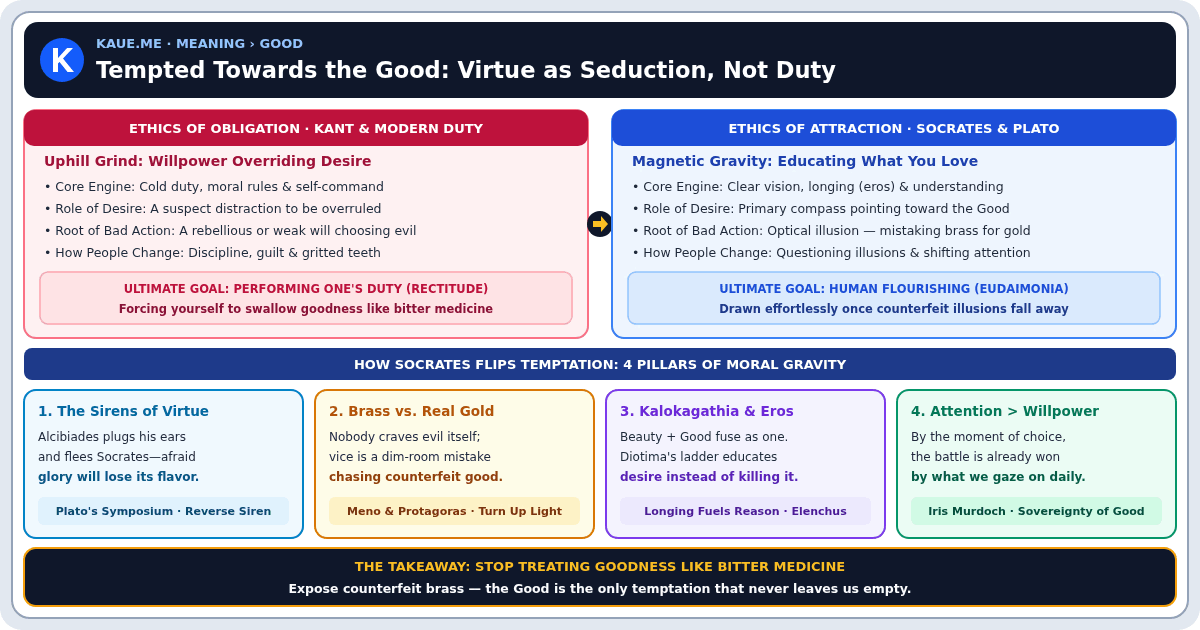
In dialogues like the Meno and the Protagoras, Socrates argues that human beings never desire what is bad for them. Vice has no independent allure of its own. When we do something destructive, cruel, or short-sighted, we aren’t succumbing to a dark craving for evil—we are falling for a counterfeit good.
Think of it as an optical illusion of the soul. We are like people in a dimly lit room mistaking shiny brass for real gold. The tyrant who seizes power, the cheat who hoards wealth, and the addict chasing a fleeting high are all aiming at what they believe will bring them happiness and wholeness (eudaimonia ). Once you turn up the lights and see the counterfeit for what it is, its hold over you evaporates, and the gravitational pull of the real Good becomes irresistible.
In the modern era—shaped heavily by the Enlightenment philosopher Immanuel Kant—morality became synonymous with obligation. In a Kantian world, desire is suspect; an action only counts as truly moral if you do it out of pure duty to the moral law, especially when you don’t want to.
Socrates lived in a completely different moral universe. For him, ethics is not about suppressing desire; it is about educating it. If you have to force yourself to be good against your own wishes, Socrates would say you haven’t yet seen what “the good” actually is.
Here is how the Socratic ethics of attraction works:
In classical Greek, the concepts of the beautiful (to kalon) and the good (to agathon) were so tightly woven together that they fused into a single compound word: kalokagathia.
Nobody needs a moral commandment or a guilt trip to feel drawn to beauty; beauty pulls the eye and the heart automatically. For Socrates, virtue isn’t a grim burden of self-denial—it is the health, harmony, and radiance of the human soul. When we see a genuinely courageous or wise life clearly, it exerts the same magnetic pull on our minds that physical beauty exerts on our senses.
Where duty-based ethics treats passion as a threat to reason, Socrates treats eros (passionate longing) as reason’s very fuel. In the Symposium, the wise woman Diotima—who defines Eros as a great daimon bridging mortals and the divine, long before Socrates’ Daimon Became Christianity’s Demon —teaches Socrates that we aren’t browbeaten into wisdom by cold rules. Instead, we are seduced up a “ladder of love”—drawn first by physical beauty, then by beautiful minds, then by just laws and knowledge, until we fall in love with the Good itself.
We don’t become virtuous by killing off our appetites, but by realizing that our lower appetites for status, flattery, or dominance are leaky, unsatisfying substitutes for what we truly crave.
If the Good is naturally magnetic, why aren’t we drawn to it all the time? Because our vision is clouded by cultural illusions and unexamined habits.
That is why Socrates never preached from a pulpit or handed down a list of “Thou Shalts.” Commands only produce outward compliance or secret rebellion; they never change what a person loves. Instead, he used the Socratic method (elenchus)—asking deceptively simple questions to expose how the things his conversation partners were chasing couldn’t actually deliver the happiness they promised. Once the illusion shatters, the soul naturally pivots toward the real thing.
| Dimension | Ethics of Obligation (e.g., Kant) | Ethics of Attraction (Socrates & Plato) |
|---|---|---|
| Core Mechanism | Willpower and obedience to moral law | Vision, longing (eros), and understanding |
| Role of Desire | A distraction or temptation to be overruled | The primary compass pointing toward the Good |
| Root of Bad Action | A rebellious or weak will choosing evil | An optical illusion—mistaking brass for gold |
| How People Change | Discipline, guilt, and self-command | Questioning illusions and redirecting attention |
| Ultimate Goal | Performing one’s duty (rectitude) | Human flourishing and harmony (eudaimonia) |
Does Socratic attraction still work in the modern world? In the 20th century, the philosopher and novelist Iris Murdoch revived this exact insight in her landmark book, The Sovereignty of Good.
Murdoch argued that modern philosophy had become obsessed with the isolated “moment of choice”—picturing the moral life as a lonely individual standing at a crossroads, using sheer muscular willpower to pick the right option at the last second.
Following Socrates and Plato, Murdoch argued that by the time the moment of choice arrives, the battle is already over. What we do in a crisis flows almost automatically from what we have spent our lives looking at, admiring, and loving.
We do not become better people by clenching our jaws and forcing ourselves to obey rules we secretly resent. We become better by practicing attention—by looking closely and honestly at the world, stripping away our egoistic illusions, and fixing our gaze on what is genuinely good, until its gravity pulls us in effortlessly.
In the end, Socrates invites us to stop treating goodness like a bitter medicine we are obligated to swallow, and to start recognizing it for what it truly is: the only temptation that never leaves us empty.
Get notified when I publish new essays, book summaries, and practical guides on living well. No spam—unsubscribe anytime.
Get the curated offline edition of Kaue's Way of Life—a practical field guide to optimizing 🍏 Health, 💰 Wealth, ❤️ Love, and 🧘 Meaning.
Challenge yourself to a fast 60-second quiz across 🔢 Math, 🌍 Geography, and 💬 Language—with replays, ghost races, and global leaderboards.
Have a question, perspective, or suggestion? Share your thoughts below. Comments are powered by GitHub Discussions (ad-free and spam-free)—click Sign in with GitHub below to comment or react (creating a free GitHub account takes less than a minute).
Updated on Nov 18, 2026.
DISCLAIMER: The content on this site is for informational and educational purposes only and does not constitute medical, psychological, financial, investment, tax, or legal advice. The ideas, curation, and opinions presented here are my own and do not represent those of my employer. Book, lecture, and article summaries are independent educational commentary and remain the intellectual property of their respective authors. AI tools may be used to assist with editing, formatting, and synthesis; while every effort is made to ensure accuracy, errors may occur. PRIVACY: This site uses no tracking cookies; browser local storage is used solely to remember optional language and playback-speed preferences, and hosting logs on Google Cloud process visitor IP addresses, browser metadata, requested resources, page engagement, and referral sources for aggregate traffic statistics. Third-party services used for optional newsletter subscriptions (Mailchimp), comments (giscus / GitHub Discussions), and media downloads/streaming (GitHub) may process visitor IP addresses and cookies in accordance with their respective privacy policies.