On paper, learning Portuguese looks like a gentle stroll. In What Are the Hardest Languages to Learn (And Why Your Brain Struggles With Them) , we saw how the U.S. Foreign Service Institute (FSI) places Portuguese squarely in Category I—the easiest tier for native English speakers alongside Spanish, French, and Italian, with an estimated 24 to 30 weeks (552 to 690 class hours) to reach professional working proficiency.
Yet ask almost anyone who has tried to move from flashcards to real-world conversation, and you will hear a very different story. Learners who breeze through reading comprehension often hit an unexpected wall the moment a native speaker opens their mouth.
The reason is simple: Portuguese hides serious complexity behind an approachable alphabet. Its sound system can make a Lisbon café sound oddly Slavic, its grammar preserves intricate structures that every other major Romance language abandoned centuries ago, and its deceptively close overlap with Spanish turns casual guessing into a minefield.
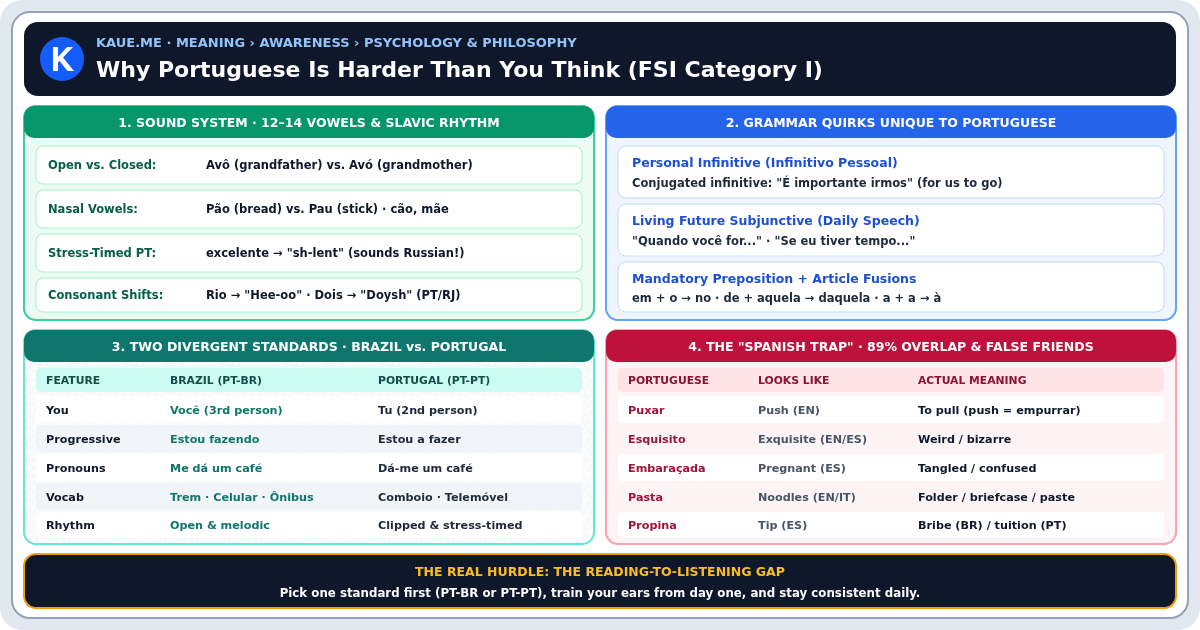
If you approach Portuguese expecting the crisp, five-vowel predictability of Spanish, your ears are in for an immediate shock. Where Spanish relies on just 5 pure vowel sounds, Portuguese uses 12 to 14 distinct vowel sounds—splitting across oral vowels, nasal vowels, and nasal diphthongs. Tiny adjustments in tongue height or airflow completely rewrite a word’s meaning.
Phonology Spotlight: Small Shifts, Different Words
- Avô (closed “o”) → Grandfather vs. Avó (open “o”) → Grandmother
- Pão (nasalized) → Bread vs. Pau (oral) → Stick / Wood
- Carro (“H”/guttural R) → Car vs. Caro (tapped R) → Expensive
- Dois → “Doy-ss” in São Paulo vs. “Doysh” in Lisbon and Rio de Janeiro
Portuguese already asks learners to juggle standard Romance-language machinery—grammatical gender, two distinct verbs for “to be” (ser and estar), and sprawling verb-conjugation tables. On top of that shared foundation, it preserves three grammatical features that feel almost alien even to seasoned polyglots.
In English, Spanish, or French, an infinitive verb (“to go,” “to speak”) is frozen and impersonal. Portuguese, uniquely among major modern Romance languages, lets you conjugate the infinitive itself to match who is performing the action. Instead of wrapping an extra clause around que, you simply attach a personal ending to the infinitive:
Once internalized, it is remarkably compact and elegant—but until your brain catches up, seeing plural endings bolted onto an infinitive breaks every Romance grammar instinct you have.
French, Italian, and everyday Spanish largely retired the future subjunctive centuries ago, replacing it with present or indicative forms. In Portuguese, it is alive and mandatory in daily conversation whenever you talk about uncertain or conditional future events—requiring its own distinct verb stem built from the third-person plural preterite:
In English, turning “do not” into “don’t” is optional. In Portuguese, prepositions, articles, and demonstratives fuse automatically—and speaking the uncontracted pieces sounds robotic or grammatically broken:
Grammar Spotlight: Built-In Grammatical Fusions
- em + o → no (in the [masc.]) | em + uma → numa (in a [fem.])
- de + aquela → daquela (of / from that)
- por + os → pelos (by / through the)
- a + a → à (to the [fem.], marked by the grave accent crase)
Studying Portuguese quickly confronts you with a strategic fork in the road. The gap between Brazilian Portuguese (PT-BR) and European Portuguese (PT-PT) runs noticeably wider than the difference between American and British English—affecting everyday pronouns, continuous verb tenses, word order, vocabulary, and vocal rhythm all at once.
| Linguistic Feature | Brazilian Portuguese (PT-BR) | European Portuguese (PT-PT) |
|---|---|---|
| Pronoun for “You” | Você (takes 3rd-person verb conjugation) | Informal Tu (2nd-person conjugation) or formal Você |
| Present Continuous | Estou fazendo (uses gerund) | Estou a fazer (a + infinitive) |
| Object Pronouns | Commonly before the verb (Me dá um café) | Placed after the verb in standard phrasing (Dá-me um café) |
| Everyday Vocabulary | Trem (train), Celular (phone), Ônibus (bus), Café da manhã (breakfast) | Comboio (train), Telemóvel (phone), Autocarro (bus), Pequeno-almoço (breakfast) |
| Vowel & Rhythm Profile | Open, melodic syllables | Clipped, stress-timed unstressed vowels |
In practice, this divergence creates a striking listening asymmetry across the Lusophone world. Because Brazilian television, music, and digital media are widely exported, speakers in Portugal are exposed to Brazilian Portuguese from childhood and usually understand it effortlessly. By contrast, Brazilians hearing rapid, stress-timed European Portuguese for the first time are often caught completely off guard—even though both speakers are reading the exact same written page.
Portuguese and Spanish share roughly 89% lexical similarity, which turns out to be a double-edged sword. In fact, mutual intelligibility between the two neighbors is famously lopsided: native Portuguese speakers can typically follow spoken Spanish fairly well, whereas native Spanish speakers often struggle to decode spoken Portuguese because its wider vowel inventory and nasal sounds blur familiar roots.
For anyone arriving with Spanish already in their head, the danger is the auto-fill trap—a tempting hybrid called Portuñol where your brain borrows Spanish vocabulary and rhythm wholesale. And just like the surprising semantic reversals we traced in From Divine Guide to Fallen Fiend: How Socrates’ Daimon Became Christianity’s Demon , shared Latin roots have drifted into sharply different—and occasionally embarrassing—meanings on opposite sides of the border.
| Portuguese Word | Looks Like | Actual Meaning | Watch Out / True Word |
|---|---|---|---|
| Puxar | English push | To pull | Classic trap on glass doors; “push” is empurrar |
| Esquisito | Exquisite / Spanish exquisito | Weird / bizarre | Complimenting a dish as esquisito insults the chef; use delicioso or requintado |
| Embaraçada | Embarrassed / Spanish embarazada | Tangled / awkward / confused | Does not mean “pregnant” (grávida) |
| Pasta | Italian/English pasta | Folder, briefcase, or paste | Noodles are macarrão or massa |
| Oficina | Spanish oficina (“office”) | Auto repair shop / workshop | An office is an escritório |
| Propina | Spanish propina (“tip”) | Bribe (Brazil) / tuition fee (Portugal) | A restaurant tip is gorjeta |
Portuguese is not secretly a Category IV marathon on par with Mandarin or Arabic. Its real surprise lies in its reading-to-listening gap: an English or Spanish speaker can decode Portuguese news headlines within a few weeks, yet feel utterly lost at conversational speed for months.
If you want to cross that gap without burning out, three small shifts make all the difference:
Accept early on that your ears will trail behind your eyes, stay steady through the nasal vowels and false friends, and you unlock one of the most expressive, musical languages on Earth—spoken by more than 260 million people across four continents.
Get notified when I publish new essays, book summaries, and practical guides on living well. No spam—unsubscribe anytime.
Get the curated offline edition of Kaue's Way of Life—a practical field guide to optimizing 🍏 Health, 💰 Wealth, ❤️ Love, and 🧘 Meaning.
Challenge yourself to a fast 60-second quiz across 🔢 Math, 🌍 Geography, and 💬 Language—with replays, ghost races, and global leaderboards.
Have a question, perspective, or suggestion? Share your thoughts below. Comments are powered by GitHub Discussions (ad-free and spam-free)—click Sign in with GitHub below to comment or react (creating a free GitHub account takes less than a minute).
Updated on Nov 23, 2026.
DISCLAIMER: The content on this site is for informational and educational purposes only and does not constitute medical, psychological, financial, investment, tax, or legal advice. The ideas, curation, and opinions presented here are my own and do not represent those of my employer. Book, lecture, and article summaries are independent educational commentary and remain the intellectual property of their respective authors. AI tools may be used to assist with editing, formatting, and synthesis; while every effort is made to ensure accuracy, errors may occur. PRIVACY: This site uses no tracking cookies; browser local storage is used solely to remember optional language and playback-speed preferences, and hosting logs on Google Cloud process visitor IP addresses, browser metadata, requested resources, page engagement, and referral sources for aggregate traffic statistics. Third-party services used for optional newsletter subscriptions (Mailchimp), comments (giscus / GitHub Discussions), and media downloads/streaming (GitHub) may process visitor IP addresses and cookies in accordance with their respective privacy policies.