If you have ever tried learning Spanish or French on an app during your morning commute, you probably noticed some reassuringly familiar territory. Words like familia or information look like English, sentences generally follow a familiar order, and the alphabet is the exact one you grew up reading.
Now imagine opening a textbook where the script runs from right to left and omits most vowels, or where a single verb mutates into twelve different forms depending on whether you are handing someone a sheet of paper, a stick, or a puppy.
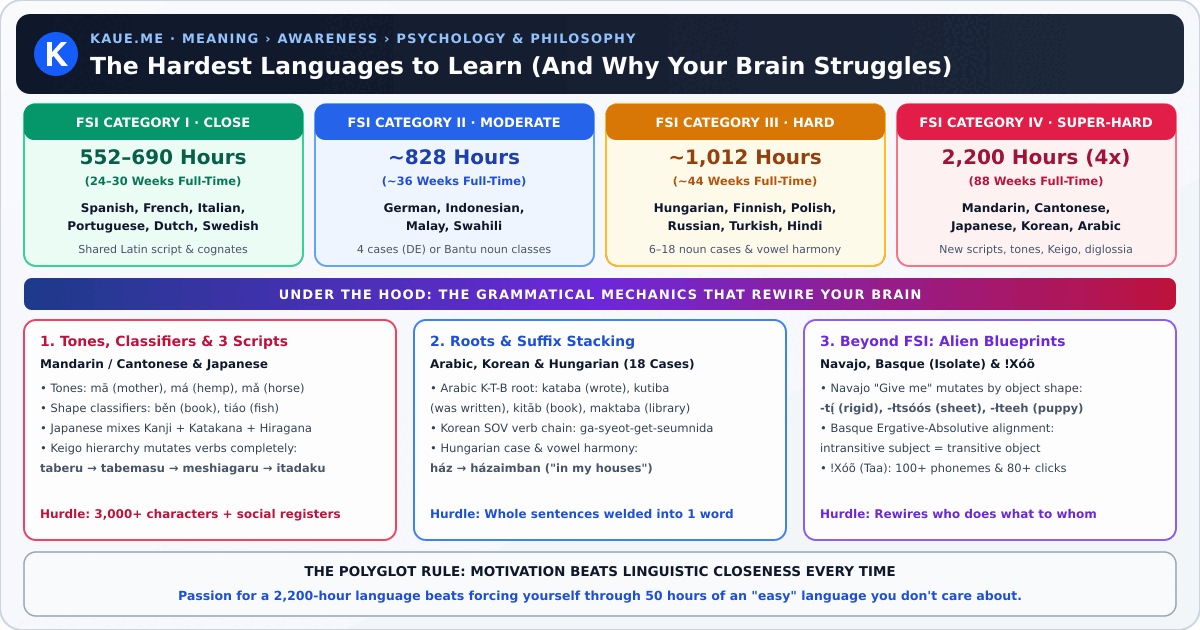
For a native English speaker, the five hardest major languages to learn are Mandarin Chinese, Cantonese, Arabic, Japanese, and Korean. According to the U.S. Foreign Service Institute (FSI)—the institution responsible for training American diplomats—these “Category IV” (super-hard) languages require roughly 88 weeks (2,200 class hours) of intensive study to reach professional working proficiency. That is nearly four times longer than Romance or Germanic languages like Spanish, Italian, or Dutch, which take between 552 and 690 class hours.
From a purely developmental standpoint, no language is objectively harder than another; toddlers in Tokyo, Budapest, and Cairo all master their native tongues at roughly the same pace. For adult learners, however, difficulty comes down to linguistic distance: how drastically a target language diverges from your native tongue in writing, sound system, vocabulary, cultural context, and—most notoriously—grammar (much like the deep historical shifts we explored in How Socrates’ Daimon Became Christianity’s Demon and From Math to Memes: The Surprising Origins of “-Maxxing” ).
Let’s break down the world’s toughest languages and look under the hood at the specific grammatical mechanics that make them so challenging.
Each of the FSI’s top-tier languages presents a distinct set of cognitive hurdles for English speakers.
At first glance, Chinese grammar looks surprisingly merciful: there are no verb conjugations, no grammatical genders, no plural noun endings, and no tenses in the European sense. Instead, the difficulty lies in its tonal phonology, logographic writing system, and reliance on subtle aspect particles and measure words.
Mandarin uses 4 main tones (plus a neutral tone), while Cantonese uses 6 to 9 tones depending on classification. A slight shift in vocal pitch completely alters the meaning of a syllable. Furthermore, reading a newspaper requires memorizing 3,000 to 4,000 distinct characters (Hanzi) that offer few phonetic clues to how they are pronounced.
Grammar Spotlight: Tones, Measure Words, and Aspect
First, pitch changes lexical meaning entirely in Mandarin:
- mā (妈 – High flat tone): Mother
- má (麻 – Rising tone): Hemp / Numb
- mǎ (馬 – Dipping tone): Horse
- mà (骂 – Falling tone): To scold
Second, you cannot simply count nouns in Chinese (e.g., “one book” or “three dogs”). Every noun requires a specific classifier (measure word) between the number and the noun based on the object’s shape or nature:
- yī běn shū (一本书): One [bound-volume-classifier] book
- yī tiáo yú (一条鱼): One [long-flexible-thing-classifier] fish
- yī zhāng zhuōzi (一张桌子): One [flat-surface-classifier] table
Finally, because verbs never conjugate for tense, context and aspect particles like le (了) or guo (过) carry the weight of time:
- Wǒ chī fàn (我吃饭): I eat rice / I am eating. (Literally: “I eat meal.”)
- Wǒ chī le fàn (我吃了饭): I ate the meal. (The particle le marks a completed action, not past tense itself—it can even be used in the future to mean “Once I have eaten…”)
Often cited by the FSI as the most time-consuming language even within Category IV, Japanese requires juggling three separate writing systems simultaneously in a single sentence:
Beyond reading, Japanese sentences run in Subject-Object-Verb (SOV) order, rely on postpositional particles, and enforce an intricate system of politeness levels and honorifics (Keigo), where verbs and vocabulary shift drastically depending on social hierarchy.
Grammar Spotlight: Three Scripts + Social Hierarchy (Keigo)
Look at how all three writing systems appear in one simple sentence: “I drank coffee at a café.”
- 私はカフェでコーヒーを飲みました。 (Watashi wa kafe de kōhī o nomimashita.)
- 私 (Watashi – “I”) and 飲 (no- – root of “drink”) are written in Kanji.
- カフェ (kafe – “café”) and コーヒー (kōhī – “coffee”) are foreign words written in Katakana.
- は (wa – topic marker), で (de – location particle “at”), を (o – direct object marker), and みました (mimashita – polite past verb ending) are written in Hiragana.
Now look at what happens to a basic verb like “to eat / drink” (taberu / nomu) depending on who you are talking to:
- Casual (to a close friend): Taberu (食べる)
- Polite (standard everyday): Tabemasu (食べます)
- Respectful / Honorific (Sonkeigo – elevating a boss or client’s action): Meshiagaru (召し上がる)
- Humble (Kenjōgo – lowering your own action before a superior): Itadaku (いただく)
The verb doesn’t just take a polite suffix—it transforms into an entirely different word!
Arabic is written from right to left in an abjad script, where letters change shape depending on whether they appear at the beginning, middle, or end of a word, and short vowels are omitted in everyday books and newspapers. You often have to already know the word and its grammatical role in the sentence just to know how to pronounce it out loud.
Its biggest practical hurdle, however, is diglossia: Modern Standard Arabic (MSA, used in news, literature, and formal speeches) differs drastically from spoken regional dialects (like Egyptian, Levantine, or Moroccan Arabic). Learners effectively have to study two versions of the language at once.
Grammar Spotlight: The Triconsonantal Root System
Unlike Indo-European languages that build words by adding prefixes and suffixes onto a static stem (like act → active → reactivation), Arabic uses non-concatenative morphology. Most words are built around a three-consonant skeleton that holds a core concept. By weaving different vowel patterns and consonants inside and around that skeleton, you generate an entire family of words.
Take the root K – T – B (ك - ت - ب), which carries the core concept of “writing”:
- KaTaBa (kataba): He wrote (past active verb)
- KuTiBa (kutiba): It was written (past passive verb—changed solely by internal vowels!)
- KiTāB (kitāb): Book
- KuTuB (kutub): Books (a “broken plural” formed by mutating internal vowels rather than adding an -s)
- KāTiB (kātib): Writer / Author
- maKTaB (maktab): Desk / Office (the prefix ma- indicates a place of action)
- maKTaBa (maktaba): Library / Bookstore
Ironically, Korean boasts what linguists widely consider the easiest, most logical writing system in the world: Hangul, a phonetic alphabet commissioned by King Sejong in 1443 that can be learned in a single afternoon.
The trap springs right after you learn the alphabet. Like Japanese, Korean uses Subject-Object-Verb (SOV) syntax, meaning the verb always comes at the very end of the sentence—so you never know if someone is buying, hating, or eating something until they finish speaking. Furthermore, Korean is highly agglutinative, stacking chains of suffixes onto verb stems to express tense, mood, causation, and seven distinct speech politeness levels.
Grammar Spotlight: Agglutinative Verb Stacking & Speech Levels
In English, we use helper words (“might have wanted to go”) to modify a verb. In Korean, those concepts are welded directly onto the verb stem 가- (ga-, “to go”):
- 가다 (ga-da): To go (dictionary form)
- 가시었다 → 가셨다 (ga-si-eot-da): Went (adding the honorific marker -si- for someone respected + past tense -eot-)
- 가셨겠습니다 (ga-syeot-get-seumnida): "[A respected person] probably went."
- 가- (ga-): root (“go”)
- -시- (-si-): subject honorific marker (elevating the person going)
- -었- (-eot-): past tense marker
- -겠- (-get-): supposition / conjecture marker (“probably / must have”)
- -습니다 (-seumnida): formal polite listener ending
You don’t need to leave the Latin alphabet to hit a linguistic brick wall. Category III languages require roughly 44 weeks (1,012 class hours) of intensive study and are famous for labyrinthine grammatical inflection.
Almost all European languages—from Spanish and English to Russian and Greek—belong to the Indo-European family. Hungarian, Finnish, and Estonian do not. They belong to the Uralic language family, meaning they share virtually zero root vocabulary with English and operate on an entirely different grammatical blueprint: heavy agglutination, vowel harmony, and 14 to 18 grammatical cases.
Instead of using prepositions like in, on, to, from, or with before a noun, Uralic languages glue cascading suffixes onto the end of the word. Furthermore, because of vowel harmony, every suffix comes in multiple versions (front-vowel vs. back-vowel) so the vowels across the entire word match acoustically.
Grammar Spotlight: Hungarian Case Stacking & Vowel Harmony
Watch how the Hungarian noun ház (house) absorbs what would be an entire phrase in English:
- ház: house
- házak: houses (plural -ak)
- házaim: my houses (possessive plural -aim)
- házaimban: in my houses (inessive case suffix -ban meaning “in”)
- házaimból: out of my houses (elative case suffix -ból meaning “out from inside”)
Because ház contains a back vowel (á), it takes the back-vowel suffix -ban (“in”). If you use the word kert (garden), which contains a front vowel (e), vowel harmony forces the suffix to mutate into -ben: kertemben (in my garden).
Slavic languages like Russian (6 cases) and Polish (7 cases) force English speakers to track the exact grammatical function of every single word in a sentence. In English, word order tells us who did what: “The dog bit the man” means the opposite of “The man bit the dog.”
In Polish and Russian, noun endings tell you who did what, meaning word order can be scrambled for emphasis while every noun, adjective, pronoun, and even number changes its suffix. Additionally, Slavic verbs come in aspect pairs (Imperfective vs. Perfective), requiring you to learn two separate verbs for almost every action depending on whether the action is ongoing or completed once.
Grammar Spotlight: Declining “My Black Cat” in Polish
Look at how the phrase “black cat” (czarny kot) mutates across Polish’s 7 grammatical cases:
- Nominative (Subject): Czarny kot śpi. (The black cat is sleeping.)
- Genitive (Possession / Negation): Nie widzę czarnego kota. (I don’t see the black cat.)
- Dative (Indirect Object): Daję mleko czarnemu kotu. (I give milk to the black cat.)
- Accusative (Direct Object): Widzę czarnego kota. (I see the black cat.)
- Instrumental (“With / By means of”): Idę z czarnym kotem. (I am walking with the black cat.)
- Locative (Location): Mówię o czarnym kocie. (I am talking about the black cat.)
- Vocative (Direct Address): O, czarny kocie! (Oh, black cat!)
Notice how in the Locative and Vocative cases, even the final consonant of the stem mutates from -t to -ci- (kot → kocie)!
Because of its geographic isolation in the North Atlantic, Icelandic has changed remarkably little since Norse settlers arrived in the 9th century. Modern Icelanders can still read medieval Viking Sagas with relative ease. For learners, however, this means mastering archaic Old Norse grammar: four cases, three genders, highly irregular verb conjugations, numbers from 1 to 4 that decline for gender and case, and a cultural policy of linguistic purism that rejects international loanwords in favor of ancient compound coinages (for example, tölva for “computer,” fused from the words for “number” and “prophetess”).
The FSI only ranks languages regularly taught to diplomats. Outside standard diplomatic curricula, several world languages push human grammar into territory that feels completely alien to Indo-European speakers.
Famously used as an unbreakable code by the U.S. Marine Corps during World War II, Navajo is a polysynthetic, verb-heavy language spoken in the American Southwest. A single Navajo verb can pack in as much information as an entire English sentence, weaving subject pronouns, object pronouns, mode, aspect, and directional prefixes into a tightly bound morphological puzzle.
Most remarkably, Navajo uses classificatory verb stems: there is no single generic verb for “to give,” “to drop,” or “to carry.” Instead, you must choose from a dozen completely different verb stems depending on the physical shape, consistency, and animacy of the object being handled.
Grammar Spotlight: Navajo Classificatory Verbs (“Give me…”)
If you want to say “Give it to me” in Navajo, the verb stem at the end of the word changes completely based on what the object looks like:
- Long, rigid object (a pen, stick, or rifle): Shaa nítį́ (Stem: -tį́)
- Flat, flexible object (a sheet of paper, blanket, or dollar bill): Shaa níłtsóós (Stem: -łtsóós)
- Single round or bulky object (a ball, book, or apple): Shaa ní*’ą́*** (Stem: -’ą́)
- Mushy or amorphous matter (mud or wet dough): Shaa nítleeh (Stem: -tleeh)
- Animate being (a puppy or a baby): Shaa níłteeh (Stem: -łteeh)
Spoken in the Pyrenees mountains between northern Spain and southwestern France, Basque is a language isolate—a pre-Indo-European survivor unrelated to any other known living language on Earth.
Beyond its completely unique vocabulary, Basque uses an ergative-absolutive grammatical alignment. In English (and almost all European languages), the subject of a sentence is always treated the same way, whether the verb has an object or not:
Basque rewires this logic completely. In Basque, the subject of an intransitive verb (“The man arrived”) is marked the exact same way as the direct object of a transitive verb (“The dog bit the man”), while the person performing a transitive action gets a special ergative suffix (-k).
Grammar Spotlight: Ergative-Absolutive Alignment in Basque
Watch what happens to the Basque word gizon (man) and mutil (boy):
- Intransitive Sentence: Gizona etorri da. ("The man has arrived.")
- Here, gizon-a is in the Absolutive case (just the base noun + -a “the”).
- Transitive Sentence: Mutilak gizona ikusi du. ("The boy has seen the man.")
- Here, “the man” (gizon-a) is now the direct object, yet it keeps the exact same Absolutive form (gizona) as when he arrived!
- Meanwhile, “the boy” (mutila), because he is performing an action onto someone else, must take the Ergative suffix -k: mutilak.
Spoken primarily in Botswana and Namibia, ǃXóõ holds the world record for the largest phoneme inventory of any language on Earth. While English gets by with roughly 44 distinct speech sounds (phonemes), ǃXóõ uses well over 100 distinct consonants and vowels, including more than 80 distinct click consonants combined with nasalization, aspiration, glottalization, and four tones. Even the exclamation-mark-like symbol at the start of its name (ǃ) represents an alveolar click sound made by snapping the tongue down from the roof of the mouth.
| FSI Category | Full-Time Study | Class Hours | Representative Languages | Primary Bottleneck for English Speakers |
|---|---|---|---|---|
| Category I (Closely Related) | 24–30 weeks | 552–690 hrs | Spanish, French, Italian, Portuguese, Dutch, Swedish | Minor verb conjugations and grammatical gender |
| Category II (Moderate Distance) | ~36 weeks | 828 hrs | German, Indonesian, Malay, Swahili | Case systems (German) or unfamiliar root vocabulary (Swahili/Indonesian) |
| Category III (Hard) | ~44 weeks | 1,012 hrs | Russian, Polish, Hungarian, Finnish, Turkish, Hindi, Vietnamese | Extensive noun cases, agglutination, tones, or non-Latin scripts |
| Category IV (Super-Hard) | 88 weeks | 2,200 hrs | Mandarin, Cantonese, Japanese, Korean, Arabic | Logographic/abjad scripts, tonal phonology, diglossia, and honorific systems |
When you look at 2,200 hours of study or 18 grammatical cases, it is easy to feel intimidated. However, veteran polyglots and linguists agree on one crucial secret: motivation and daily consistency beat linguistic closeness every single time (especially when paired with the Architect-vs-Builder habit system in Don’t Let Your Mood Vote on Your Schedule ).
A learner who is deeply passionate about Japanese cinema, Korean music, or Arabic history will gladly show up for 2,000 hours of practice and reach fluency, whereas someone forcing themselves to study a “Category I” language they don’t care about will quit after 50 hours. Every “impossible” grammatical feature—whether it is Chinese tones, Hungarian suffixes, or Basque ergativity—is simply a different way the human mind has found to organize reality.
Get notified when I publish new essays, book summaries, and practical guides on living well. No spam—unsubscribe anytime.
Get the curated offline edition of Kaue's Way of Life—a practical field guide to optimizing 🍏 Health, 💰 Wealth, ❤️ Love, and 🧘 Meaning.
Have a question, perspective, or suggestion? Share your thoughts below. Comments are powered by GitHub Discussions (ad-free and spam-free)—click Sign in with GitHub below to comment or react (creating a free GitHub account takes less than a minute).
Updated on Nov 13, 2026.
DISCLAIMER: The content on this site is for informational and educational purposes only and does not constitute medical, psychological, financial, investment, tax, or legal advice. The ideas, curation, and opinions presented here are my own and do not represent those of my employer. Book, lecture, and article summaries are independent educational commentary and remain the intellectual property of their respective authors. AI tools may be used to assist with editing, formatting, and synthesis; while every effort is made to ensure accuracy, errors may occur. PRIVACY: This site uses third-party services for optional newsletter subscriptions (Mailchimp), comments (giscus / GitHub Discussions), and embedded media (YouTube), which may process visitor IP addresses and cookies in accordance with their respective privacy policies.