Kaue's Way of Life
Every major philosophical and religious system eventually forces us to confront a fundamental fork in the road: the choice to live. But what exactly does that mean? And more importantly, what happens if we don’t make that choice?
When we look at two radically different worldviews—Ayn Rand’s secular philosophy of Objectivism and the ancient tenets of Christianity—we find that both view the “choice to live” as the fundamental dividing line of human existence. However, the consequences they outline for failing to make that choice couldn’t be more different.
Let’s dive into how these two systems answer the ultimate ultimatum.
In Ayn Rand’s Objectivism, a strictly materialist and rationalist philosophy, the choice to live is the pre-moral baseline that makes all other values possible. Rand famously argued that “life or death is man’s only fundamental alternative.”
Because humans do not have automatic survival instincts that tell us exactly how to build a shelter, cure a disease, or grow crops, we must choose to use our minds to survive. If you refuse to make the choice to live—and by extension, the choice to think rationally—nature is unforgiving.
Here is what happens:
In Christianity, “choosing life” isn’t just about biological survival or rational self-interest; it is synonymous with choosing God. The concept is deeply rooted in scriptures like Deuteronomy 30:19 (“I have set before you life and death… therefore choose life”) and Jesus’s declaration that he is “the way, the truth, and the life.”
God is viewed as the literal source and sustainer of life. Therefore, rejecting the choice to live is ultimately a rejection of the Creator.
Here is the Christian perspective on the consequences:
At their core, both systems warn us that apathy is not an option. You cannot simply float through existence.
For the Objectivist, failing to choose life means abandoning reality and reason, leading to earthly misery, dependence, and physical non-existence.
For the Christian, failing to choose life means rejecting God, leading to spiritual corruption in this world and eternal separation in the next.
Whether you are looking through the lens of secular reason or divine revelation, the message remains starkly clear: life is not a given; it is a choice. And the consequences of that choice echo through the rest of your existence.
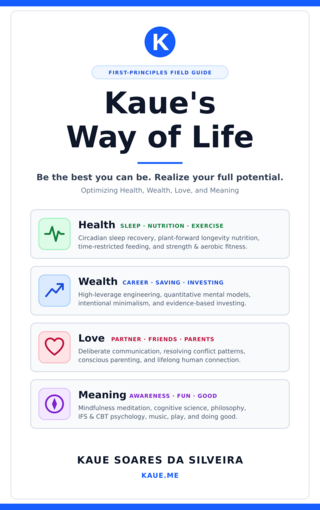
Get the curated offline edition of Kaue's Way of Life—a practical field guide to optimizing 🍏 Health, 💰 Wealth, ❤️ Love, and 🧘 Meaning.
Get notified when I publish new essays, book summaries, and practical guides on living well. No spam—unsubscribe anytime.
Have a question, perspective, or suggestion? Share your thoughts below.
Updated on 2026 Oct 19.
DISCLAIMER: The content on this site is for informational and educational purposes only and does not constitute medical, psychological, financial, investment, tax, or legal advice. The ideas, curation, and opinions presented here are my own and do not represent those of my employer. Book, lecture, and article summaries are independent educational commentary and remain the intellectual property of their respective authors. AI tools may be used to assist with editing, formatting, and synthesis; while every effort is made to ensure accuracy, errors may occur. PRIVACY: This site uses third-party services for cookieless analytics (Google Analytics), optional newsletter subscriptions (Mailchimp), comments (Disqus), live chat (Tawk.to), and embedded media (YouTube), which may process visitor IP addresses and cookies in accordance with their respective privacy policies.