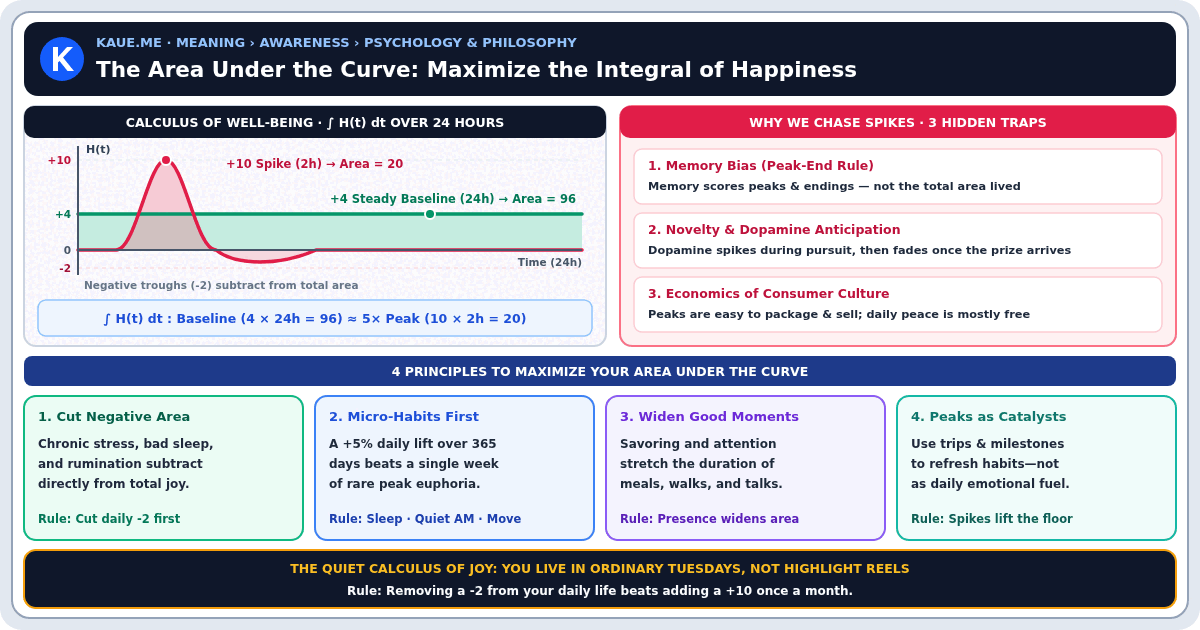
We live in a culture obsessed with peak experiences. We scroll through social media highlight reels, plan for grand vacations, chase career milestones, and wait for special occasions to feel truly alive. In mathematical terms, we spend the majority of our energy trying to optimize the maximum peak height of our happiness function at any given moment.
Yet if your goal is a deep, abiding sense of fulfillment across a lifetime, optimizing for isolated peaks is a fundamental error in calculus.
What actually determines a well-lived life isn’t the height of a few dramatic spikes; it is the integral of happiness over time—the total area under the curve.
Imagine your moment-to-moment happiness as a continuous function over time, H(t), defined across the span of your life from start to finish (t = 0 to t = T).
When we evaluate how a day, a decade, or a lifetime actually felt to live through, what matters is the cumulative sum of those moments:
Here, H(t) represents your net emotional state at time t, and T represents the total timespan—whether a single day, a decade, or an entire lifetime.
Now compare two distinct life trajectories:
Trajectory A experiences dramatic highs—a promotion, a wild party, a luxury purchase, or an exotic trip. For a brief burst of roughly 2 hours, happiness spikes all the way up to +10. Across the remaining 22 hours of the day, however, the net state averages around 0, as mild exhaustion, hedonic comedown, and everyday friction cancel out lukewarm moments:
Trajectory B experiences fewer sensational highs—its curve rarely surges past +5 or +6. Instead, Trajectory B invests steadily in elevating its daily baseline. Through consistent sleep, strong relationships, engaging work, low daily friction, and peace of mind, the default state sits comfortably at +4 across all 24 hours:
Across a single day, Trajectory B’s steady baseline yields 96 units versus Trajectory A’s 20 units—nearly five times (almost 500%) more cumulative well-being than a spectacular spike surrounded by exhaustion or mediocrity. Even if the Peak Chaser’s off-peak 22 hours held steady at a lukewarm +1 (yielding 20 + 22 = 42 units), the Baseline Elevator’s 96 units still delivers more than double the total happiness over the same 24 hours.
| Dimension | Trajectory A: The Peak Chaser | Trajectory B: The Baseline Elevator |
|---|---|---|
| Peak Intensity | Dramatic spikes (+10 for ~2 hours) | Modest highs (+4 to +6) |
| Everyday Baseline | Near 0 (oscillating between +1 and comedowns) | Steady +4 across ordinary hours |
| 24-Hour Total Area | 20 units (42 even at +1 baseline) | 96 units (nearly 5× higher) |
| Primary Driver | Novelty, status milestones, external thrills | Sleep, calm routines, low friction, deep bonds |
| Hidden Trap | Burnout, hedonic adaptation, chasing the next rush | Easily overlooked because ordinary peace rarely boasts |
If the math favors the area under the curve so heavily, why do we default to chasing spikes?
To shift your life design from chasing occasional peaks to maximizing the cumulative integral over time, focus on two levers: elevating the baseline and extending the duration of positive states. Here are four practical principles:
In calculus, values below the horizontal axis subtract directly from positive area. Chronic anxiety, unresolved relationship conflict, poor sleep, and toxic environments create deep, prolonged negative troughs that erase the gains of good moments. Worse still, we often amplify unavoidable setbacks through self-inflicted rumination—what The Prison of the Mind: How to Stop Shooting the ‘Second Arrow’ unpacks as optional mental suffering layered onto inevitable pain. Eliminating a recurring source of daily dread adds far more total area to your life than booking an exciting weekend getaway.
Rule: Removing a -2 from your daily life does more for your lifetime integral than adding a +10 once a month.
A modest 5% lift in everyday well-being sustained across 365 days compounds into vastly more cumulative fulfillment than a single week of pure euphoria. Instead of waiting for the next big milestone, invest in small, repeatable upgrades anchored into daily systems—the same structure behind Don’t Let Your Mood Vote on Your Schedule
, so your baseline holds steady even when motivation dips:
You can expand the width of any good experience through savoring and deliberate attention. When something enjoyable happens—a well-cooked meal, an unhurried walk, or a genuine laugh with a friend—put the phone away and slow down enough to actually register it while it is happening. Presence widens the rectangle under the curve without requiring extra money or intensity.
Peak experiences aren’t the enemy; they simply make terrible daily fuel. An exciting trip, a hard-earned milestone, or a meaningful celebration works best as a catalyst—a spark that deepens shared memories, widens your perspective, or inspires a lasting upgrade to your ordinary habits. Enjoy peaks fully when they arrive, just don’t expect them to carry the emotional weight of the rest of the calendar.
When you look back on a year, a decade, or a life, you won’t actually live inside the highlight reel. You will live inside thousands of ordinary Tuesdays, quiet mornings, routine commutes, and unremarkable evenings.
If those everyday hours sit at a baseline of ambient anxiety or dull exhaustion, no weekend getaway or career milestone can make up for the lost area under the curve.
Stop asking: “What will give me the biggest rush today?”
Start asking: “What small change can I make today that gently lifts the floor of my entire life?”
Maximize the integral. Elevate the baseline. That is where a rich life truly accumulates.
If you could remove one recurring -2 from your ordinary Tuesday—or add one small daily +1 to your baseline—which change would move your lifetime integral the most?
Get notified when I publish new essays, book summaries, and practical guides on living well. No spam—unsubscribe anytime.
Get the curated offline edition of Kaue's Way of Life—a practical field guide to optimizing 🍏 Health, 💰 Wealth, ❤️ Love, and 🧘 Meaning.
Challenge yourself to a fast 60-second quiz across 🔢 Math, 🌍 Geography, and 💬 Language—with replays, ghost races, and global leaderboards.
Have a question, perspective, or suggestion? Share your thoughts below. Comments are powered by GitHub Discussions (ad-free and spam-free)—click Sign in with GitHub below to comment or react (creating a free GitHub account takes less than a minute).
Updated on Nov 26, 2026.
DISCLAIMER: The content on this site is for informational and educational purposes only and does not constitute medical, psychological, financial, investment, tax, or legal advice. The ideas, curation, and opinions presented here are my own and do not represent those of my employer. Book, lecture, and article summaries are independent educational commentary and remain the intellectual property of their respective authors. AI tools may be used to assist with editing, formatting, and synthesis; while every effort is made to ensure accuracy, errors may occur. PRIVACY: This site uses no tracking cookies; browser local storage is used solely to remember optional language and playback-speed preferences, and hosting logs on Google Cloud process visitor IP addresses, browser metadata, requested resources, page engagement, and referral sources for aggregate traffic statistics. Third-party services used for optional newsletter subscriptions (Mailchimp), comments (giscus / GitHub Discussions), and media downloads/streaming (GitHub) may process visitor IP addresses and cookies in accordance with their respective privacy policies.