We all know the bedtime-story version of the myth. Driven by irresistible curiosity, Pandora lifts the lid of a forbidden box (which, in ancient Greek, was actually a large earthenware storage jar called a pithos). Instantly, every imaginable misery—sickness, sorrow, greed, and death—flies out to plague humanity. Horrified, Pandora slams the lid shut just in time to trap one final thing at the very bottom: Hope.
Usually, the story ends there with a comforting moral: No matter how dark the world gets, we still have hope.
Wait a second. Think about the mechanics of that story for a moment.
If all the evils of the world escaped the jar to infect humanity, and Hope was trapped inside, doesn’t that mean Hope was kept away from us? Furthermore, why was Hope—supposedly a wonderful blessing—sitting inside a jar explicitly packed with curses designed by a vengeful Zeus to torture mankind?
For millennia, scholars, philosophers, and poets have wrestled with this exact paradox in Hesiod’s Works and Days, the ancient text where the myth originates (much like the linguistic twist behind How Socrates’ Daimon Became Christianity’s Demon ). From this debate, two starkly different interpretations have emerged.
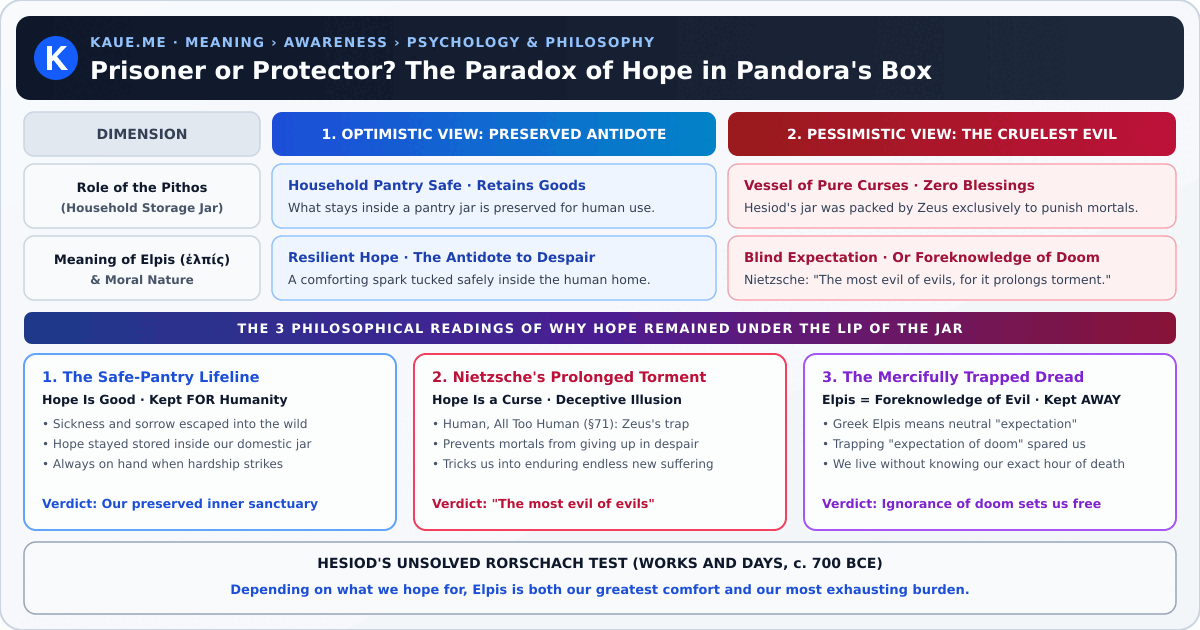
The most common way we interpret the myth today is that Hope was a blessing saved just in the nick of time. Look at it this way: a pithos wasn’t a mystical portal; it was a household pantry jar used to store wine, olive oil, or grain.
To make the optimistic view work, scholars suggest we have to look at how a pantry jar functions. When provisions are kept inside a household jar, they are preserved for the homeowner’s use. When they spill out or escape, they are lost or run wild.
Under this lens, the story shifts:
In this reading, Zeus wasn’t entirely heartless. While he punished humanity for receiving the stolen fire from Prometheus, he allowed Pandora to slam the lid shut so humans wouldn’t be completely broken by despair. Hope is our lifeline.
Here is where the myth takes a much darker turn. If you read Hesiod’s original Greek text closely, there is no mention of the jar containing “curses and one blessing.” The jar contained only evils.
If everything in the jar was put there to punish humans, then Hope (Elpis in Greek) wasn’t the antidote to the evils—it was one of them.
Why would Hope be considered a curse? The 19th-century philosopher Friedrich Nietzsche (whose collision with classical Greek thought we explored in The Gadfly and the Hammer: Why Nietzsche Couldn’t Stop Fighting Socrates ) summed up this ancient Greek pessimism brilliantly in Human, All Too Human:
“Zeus did not want man to throw his life away, no matter how much the other evils might torment him, but rather to go on letting himself be tormented anew. To that end, he gave man hope. In truth, it is the most evil of evils because it prolongs man’s torment.”
Under this darker interpretation, there are two ways to look at what happened when the lid was closed:
The beauty of the Pandora myth is that Hesiod never resolves the riddle. He simply writes that Elpis remained inside under the lip of the jar, leaving us to figure out what that means for the human condition.
It serves as a philosophical Rorschach test for how you view the world:
Perhaps the ancient Greeks understood that Hope isn’t purely good or purely evil. Depending on the day, and what we are hoping for, it can be both our greatest comfort and our most exhausting burden.
Get notified when I publish new essays, book summaries, and practical guides on living well. No spam—unsubscribe anytime.
Get the curated offline edition of Kaue's Way of Life—a practical field guide to optimizing 🍏 Health, 💰 Wealth, ❤️ Love, and 🧘 Meaning.
Have a question, perspective, or suggestion? Share your thoughts below. Comments are powered by GitHub Discussions (ad-free and spam-free)—click Sign in with GitHub below to comment or react (creating a free GitHub account takes less than a minute).
Updated on Nov 10, 2026.
DISCLAIMER: The content on this site is for informational and educational purposes only and does not constitute medical, psychological, financial, investment, tax, or legal advice. The ideas, curation, and opinions presented here are my own and do not represent those of my employer. Book, lecture, and article summaries are independent educational commentary and remain the intellectual property of their respective authors. AI tools may be used to assist with editing, formatting, and synthesis; while every effort is made to ensure accuracy, errors may occur. PRIVACY: This site uses third-party services for optional newsletter subscriptions (Mailchimp), comments (giscus / GitHub Discussions), and embedded media (YouTube), which may process visitor IP addresses and cookies in accordance with their respective privacy policies.