Kaue's Way of Life
If you’ve spent any time on the internet recently, you’ve probably seen someone talking about optimizing their life. Maybe a finance bro is talking about “token maxing” their crypto portfolio. Maybe a TikToker is sharing a “looksmaxxing” routine. Or maybe a gamer is talking about their “min-maxed” character build.
At first glance, these concepts — artificial intelligence, decentralized finance, Dungeons & Dragons, and Gen Z beauty trends — seem entirely unrelated. But they actually share a fascinating etymological root. They all represent a conceptual shift where we treat life, money, and our physical bodies like a role-playing game (RPG) stat sheet.
Let’s look at how a 1920s mathematical theory mutated into ubiquitous internet slang.
The grandfather of the phrase comes from academia. In 1928, mathematician John von Neumann published the “minimax” theorem, a decision rule used in zero-sum game theory.
The strategy is exactly what it sounds like: minimize the maximum possible loss. Today, it is a foundational concept in Artificial Intelligence. When an AI plays chess or tic-tac-toe against you, a minimax algorithm assumes you will play perfectly, and it calculates the best possible move to limit its own worst-case scenarios.
Decades later, tabletop gamers — specifically Dungeons & Dragons players — took this defensive mathematical term and turned it into an offensive gameplay strategy.
In RPGs, you have a limited pool of points to build a character. “Min-maxing” became the practice of deliberately minimizing all irrelevant stats (like charisma for a brute-force warrior) to absolutely maximize one specific combat stat (like strength). It created unbalanced, hyper-optimized characters. Gamers had taken a math theorem and turned it into a way to hack a fantasy game.
In the 2010s, the term jumped from fantasy games to real life. The “min” was dropped, and the “-maxxing” suffix was born in niche self-improvement and internet forums.
“Looksmaxxing” applies the gamer mindset to human appearance. Instead of leveling up a virtual avatar’s armor, people use skincare, fitness routines, and styling to optimize their physical attractiveness. It treats human beauty not as a genetic lottery, but as a solvable, optimizable equation.
Today, the “-maxxing” suffix has broken containment. It is used both seriously and ironically across the web:
The linguistic journey from a 1928 math paper to modern TikTok slang highlights a broader cultural trend: hyper-optimization. Whether it’s a computer calculating a chess move, a gamer building a wizard, or a trader staking crypto, the underlying philosophy is identical. We are hacking the system to squeeze out the highest possible numerical value.
We have gamified reality.
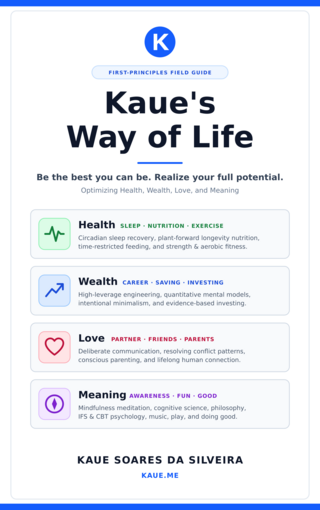
Get the curated offline edition of Kaue's Way of Life—a practical field guide to optimizing 🍏 Health, 💰 Wealth, ❤️ Love, and 🧘 Meaning.
Get notified when I publish new essays, book summaries, and practical guides on living well. No spam—unsubscribe anytime.
Have a question, perspective, or suggestion? Share your thoughts below.
Updated on 2026 Oct 1.
DISCLAIMER: The content on this site is for informational and educational purposes only and does not constitute medical, psychological, financial, investment, tax, or legal advice. The ideas, curation, and opinions presented here are my own and do not represent those of my employer. Book, lecture, and article summaries are independent educational commentary and remain the intellectual property of their respective authors. AI tools may be used to assist with editing, formatting, and synthesis; while every effort is made to ensure accuracy, errors may occur. PRIVACY: This site uses third-party services for cookieless analytics (Google Analytics), optional newsletter subscriptions (Mailchimp), comments (Disqus), live chat (Tawk.to), and embedded media (YouTube), which may process visitor IP addresses and cookies in accordance with their respective privacy policies.