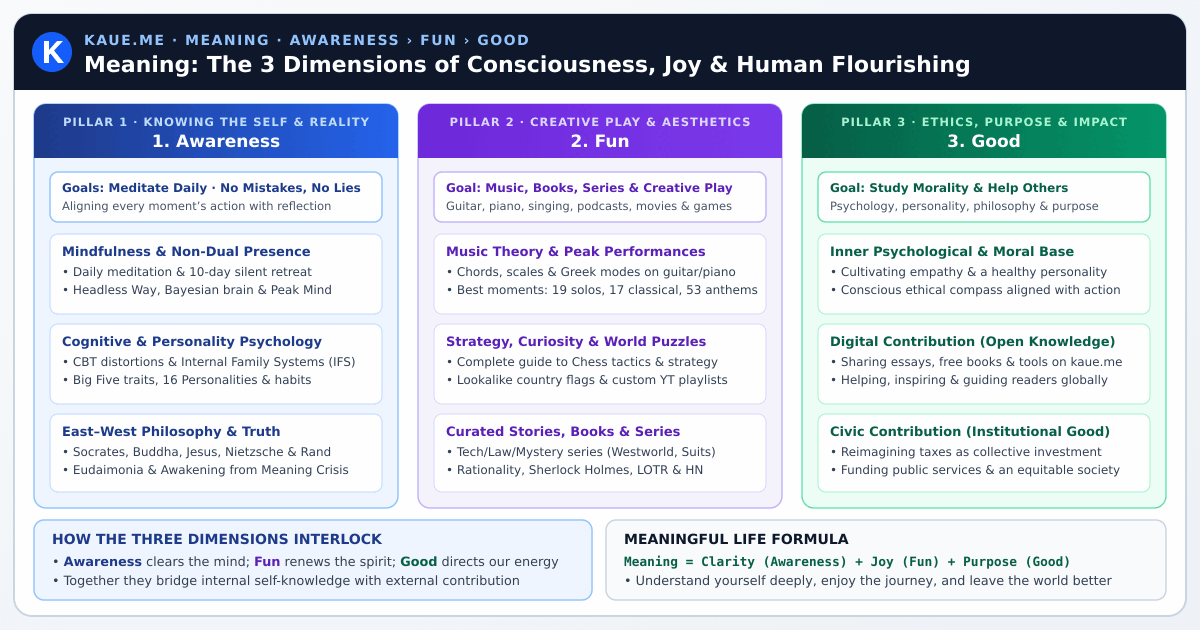
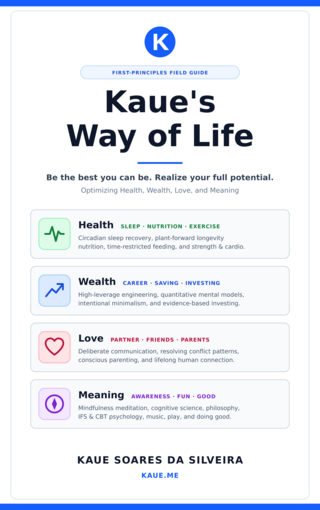
Exploring human consciousness, psychology, philosophy, and the things that make life enjoyable.
Welcome to the Meaning hub. This collection of notes, summaries, and essays represents my ongoing journey to understand the world and ourselves. It is divided into three core pillars: Awareness, Fun, and Good.
Below, you’ll find categorized resources ranging from deep-dives into cognitive psychology to my favorite guitar solos.
📝 Your Mind is an Excellent Servant, but a Terrible Master An exploration of David Foster Wallace's 2005 Kenyon commencement address ('This is Water') on conscious attention, overcoming default self-centeredness, and choosing what we worship.
📝 The Headless Way: A Guided Meditation An experiential guide to the classic Pointing Experiment based on the teachings of Douglas Harding and Richard Lang.
📝 Shamil Chandaria: The Bayesian Brain and Meditation A predictive processing account of radical changes in phenomenal experience, awakening, enlightenment, and liberation based on Shamil Chandaria's lecture.
📝 From Math to Memes: The Surprising Origins of '-Maxxing' If you've spent any time on the internet recently, you've probably seen someone talking about optimizing their life. Maybe a finance bro is talking about 'token maxing' their crypto portfolio. Maybe a TikToker is sharing a 'looksmaxxing' routine. Or maybe a gamer is talking about their 'min-maxed' character build. Let's look at how a 1920s mathematical theory mutated into ubiquitous internet slang.
📝 The Prison of the Mind: How to Stop Shooting the 'Second Arrow' Our minds that act as filters. We label our experiences, and in doing so, we often build mental cages of our own design. This concept is the bedrock of Stoic philosophy, modern Cognitive Behavioral Therapy (CBT), and an ancient Buddhist teaching that gives us a perfect metaphor for human suffering: The Parable of the Two Arrows.
📝 The Ultimate Ultimatum: What Happens When We Refuse to 'Choose Life'? Comparing how Ayn Rand's secular philosophy of Objectivism and the ancient tenets of Christianity define the fundamental 'choice to live'—and the vastly different consequences they outline for refusing it.
📝 The Ultimate Goal: How the World's Four Major Religions Seek Liberation How the four major world religions—Christianity, Islam, Hinduism, and Buddhism—understand the human predicament and the path to ultimate liberation, with a breakdown of essential theological and philosophical terms.
📝 The History of Western Philosophy: Thales to Aquinas A comprehensive summary of the foundational thinkers of Western civilization—from the Pre-Socratics, Socrates, Plato, and Aristotle to Thomas Aquinas—based on the lectures of Leonard Peikoff.
📝 The Unexpected Harmony: Unifying Ayn Rand and the Sermon on the Mount At first glance, attempting to unify Ayn Rand’s Objectivism with Jesus of Nazareth’s Sermon on the Mount seems like an impossible paradox. Rand famously regarded the Sermon as the ultimate blueprint for the 'evil' of altruism, while traditional theologians often view Rand's exaltation of rational selfishness and pride as inherently sinful.
📝 Can We Actually Prove Murder is Wrong? The Illusion of Objective Morality It’s the most universally accepted moral rule in human history: murder is wrong. But if someone were to ask you to prove it, how would you do it? Because empirical proof is impossible, philosophers and theologians have spent centuries building elaborate frameworks to logically deduce the wrongness of murder. Let's look at a few, and then look at the ultimate 'catch' that undermines them all.
📝 Beyond the Ego: How Healthy Pride and True Humility Coexist (and Create Better Leaders) We use one word ”pride” to describe both dangerous narcissism and the profound joy a parent feels for their child. By untangling these definitions, we can understand not only how a healthy sense of pride coexists with true humility, but how together they form the bedrock of the most effective leadership model in both theology and modern business: Servant Leadership.
📝 The Biological OS: Mapping Human Consciousness to Computer Architecture Have you ever wondered how your brain manages to process the blinding complexity of reality while your conscious mind struggles to remember a six-digit verification code? If we look at cognitive science through the lens of computer architecture, the answer becomes surprisingly clear: **Consciousness is located in the processor. Everything else is unconscious computation.** By placing consciousness squarely in the CPU and defining the rest of the brain's activity as background processes, we can map out the human mind using standard computer hardware concepts. Here is a deep dive into how your 'Biological OS' handles daily tasks, software bugs, system maintenance, and altered states.
📝 Internal Family Systems (IFS) Explained: A Guide to "Parts Work" An accessible breakdown of the neuroscience and psychology of Internal Family Systems (IFS) therapy—exploring the multiplicity of the mind, the True Self, Exiles, Protectors, and Unblending.
📝 9 Questions to Check if a Habit Has Become an Addiction Nine universal clinical questions to evaluate whether any habit or behavior—from work and shopping to gaming and scrolling—has crossed the line into an addiction.
📝 Mastering Music Chords, Scales, and Greek Modes A practical guide to how scales generate diatonic chords, what the seven Greek modes actually are, and how to match any chord to its compatible scales.
📝 The Best Parts of 17 Classical & Instrumental Masterpieces A curated playlist featuring the best moments of 17 classical and instrumental tracks—from electric rock covers and piano virtuosity to orchestral swells and South American rhythms.
📝 The Absolute Best Parts of 19 Legendary Guitar Solos A curated playlist of the greatest moments across 19 phenomenal guitar solos—from neoclassical shredders and thrash titans to power metal and acoustic masters.
Have a question, perspective, or suggestion? Share your thoughts below. Comments are powered by GitHub Discussions (ad-free and spam-free)—click Sign in with GitHub below to comment or react (creating a free GitHub account takes less than a minute).
DISCLAIMER: The content on this site is for informational and educational purposes only and does not constitute medical, psychological, financial, investment, tax, or legal advice. The ideas, curation, and opinions presented here are my own and do not represent those of my employer. Book, lecture, and article summaries are independent educational commentary and remain the intellectual property of their respective authors. AI tools may be used to assist with editing, formatting, and synthesis; while every effort is made to ensure accuracy, errors may occur. PRIVACY: This site uses third-party services for comments (giscus / GitHub Discussions) and embedded media (YouTube), which may process visitor IP addresses and cookies in accordance with their respective privacy policies.