We have all been there: staring at a blinking cursor, dreading a difficult email or struggling to find the right words for a delicate text message. Enter generative AI—the ultimate cure for writer’s block. Within seconds, it can draft a polite decline, a sensitive HR notice, or a heartfelt apology.
There is just one catch: you actually have to read it before you hit send.
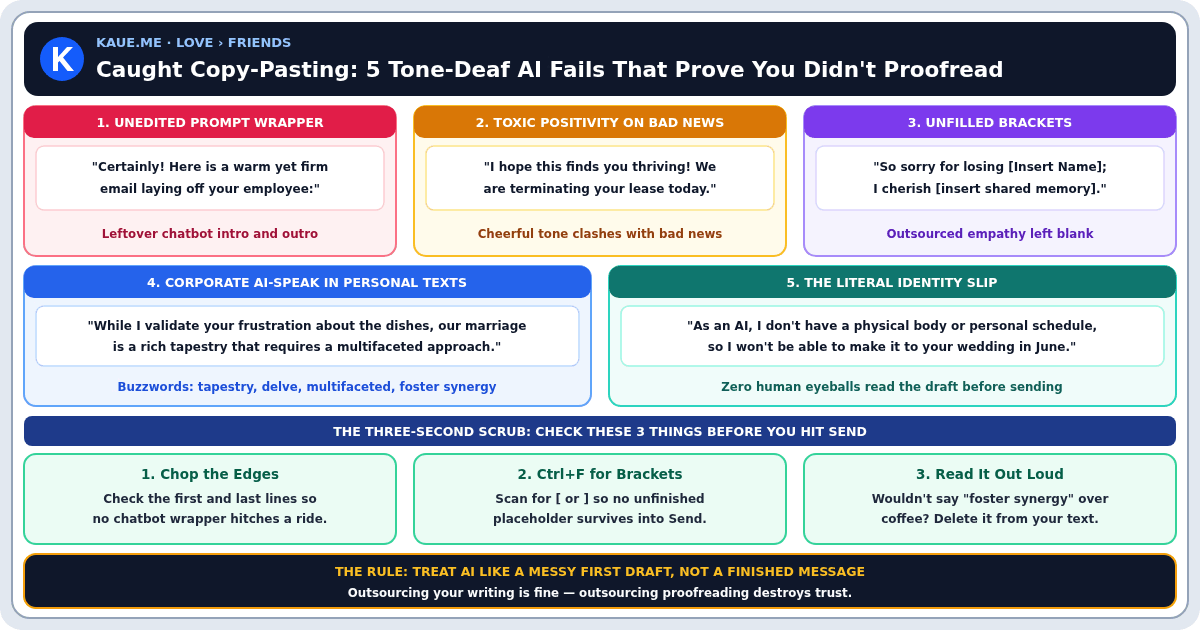
When people hit Phase 2 of the AI Trust Pendulum—blind copy-paste abdication , nothing evaporates human trust faster than realizing the person on the other end of a sensitive conversation didn’t even care enough to proofread the robot they outsourced their empathy to. From toxic positivity during a crisis to leftover prompt instructions, here are the five most painful, tone-deaf tells that prove someone blindly copy-pasted their AI output.
Large language models are trained to be eager, helpful assistants. Because of this, they love to sandwich their output between a cheerful preamble and an offer to make revisions. When you highlight the whole screen, hit Ctrl+C, and paste it directly into an email, you aren’t just sending the message—you are exposing your exact instructions to the recipient.
Why it hurts: It strips away any illusion of genuine communication. Worse, the prompt wrapper often reveals the cold, calculated mechanics behind a message that was supposed to feel personal.
Left to their own devices, AI chatbots default to a bright, enthusiastic corporate customer-service voice. If you ask an AI to draft a message delivering terrible news without explicitly instructing it to somber its tone, it will cheerfully mash standard email pleasantries right up against life-altering announcements.
Why it hurts: The jarring whiplash between performative enthusiasm and devastating news makes the sender look completely detached from reality.
When an AI doesn’t know the specific details of your life, it smartly leaves placeholders in brackets so you can fill in the blanks later. However, when someone is in a rush to outsource their emotional labor, those brackets become a brutal game of unfinished Mad Libs.
Why it hurts: Seeing a bracketed placeholder in a sales pitch is embarrassing; seeing one in a sympathy card or an anniversary text is relationship-ending. Especially when words carry the deepest emotional weight in your closest relationships , an unfilled bracket proves the sender didn’t even spend five seconds thinking about the person they were writing to.
AI models have a well-documented obsession with certain words—delve, testament, tapestry, multifaceted, foster, and synergy show up constantly. While you might get away with this vocabulary in a quarterly business review, pasting it into a messaging thread with your spouse or best friend makes you sound like an alien masquerading as a middle manager.
Why it hurts: Nobody talks like this to the people they love. Bringing boardroom buzzwords into a domestic disagreement instantly signals that you handed your phone over to a chatbot to win an argument.
Sometimes, if you ask an AI a direct question meant for yourself—like how to RSVP “no” to an event—the model forgets it is ghostwriting for a human and answers from its own perspective. Just like our favorite AI-era engineering fails , copying and pasting without looking produces a hilarious existential confession:
Why it hurts: Honestly, this one hurts a little less because of sheer comedic value. Still, good luck explaining to the bride and groom why you claimed not to have a physical form.
Using AI to help draft tough messages isn’t inherently bad—sometimes we all need a starting framework when we are overwhelmed or stuck. Before hitting send, scan for the five classic tells:
| AI Copy-Paste Fail | The Dead Giveaway | What It Signals to the Reader |
|---|---|---|
| 1. Unedited Prompt Wrapper | “Certainly! Here is a warm yet firm email…” | You didn’t even trim the chatbot’s intro/outro |
| 2. Toxic Positivity | “I hope this finds you thriving!” before bad news | Performative cheerfulness detached from reality |
| 3. Unfilled Brackets | [Insert Name of Deceased] / [specific trait] | You outsourced a personal moment without reading it |
| 4. Corporate AI-Speak | Tapestry, multifaceted, delve, foster synergy | A middle-manager bot replied to your loved one |
| 5. Literal Identity Slip | “As an AI, I don’t have a physical body…” | Zero human eyeballs touched the draft |
To make sure your assistive tech doesn’t turn into a social disaster, run the Three-Second Scrub:
[ or ] to make sure no fill-in-the-blank instructions survived.Treat AI like a messy first draft, not a finished product. Your relationships (and your reputation) will thank you.
Get notified when I publish new essays, book summaries, and practical guides on living well. No spam—unsubscribe anytime.
Get the curated offline edition of Kaue's Way of Life—a practical field guide to optimizing 🍏 Health, 💰 Wealth, ❤️ Love, and 🧘 Meaning.
Challenge yourself to a fast 60-second quiz across 🔢 Math, 🌍 Geography, and 💬 Language—with replays, ghost races, and global leaderboards.
Have a question, perspective, or suggestion? Share your thoughts below. Comments are powered by GitHub Discussions (ad-free and spam-free)—click Sign in with GitHub below to comment or react (creating a free GitHub account takes less than a minute).
Updated on Nov 24, 2026.
DISCLAIMER: The content on this site is for informational and educational purposes only and does not constitute medical, psychological, financial, investment, tax, or legal advice. The ideas, curation, and opinions presented here are my own and do not represent those of my employer. Book, lecture, and article summaries are independent educational commentary and remain the intellectual property of their respective authors. AI tools may be used to assist with editing, formatting, and synthesis; while every effort is made to ensure accuracy, errors may occur. PRIVACY: This site uses no tracking cookies; browser local storage is used solely to remember optional language and playback-speed preferences, and hosting logs on Google Cloud process visitor IP addresses, browser metadata, requested resources, page engagement, and referral sources for aggregate traffic statistics. Third-party services used for optional newsletter subscriptions (Mailchimp), comments (giscus / GitHub Discussions), and media downloads/streaming (GitHub) may process visitor IP addresses and cookies in accordance with their respective privacy policies.