Recently, someone close to me sent me a message that made me pause:
“I think that’s one thing I admire about you—how you stick to your routine no matter what. I remember how you don’t let your mind dictate terms or moods, and still do things it doesn’t want to once it’s put on your timetable.”
From the outside, that kind of consistency can look like iron willpower, or a brain that somehow enjoys the grind. From the inside, I know the truth: my mind resists things all the time. I have moods, low-energy days, and moments where the last thing I want to do is whatever is sitting on my calendar.
The difference isn’t that I don’t feel resistance. It’s that I don’t give that resistance a veto vote.
When I thought about how I actually operate day to day, my reply came down to one sentence:
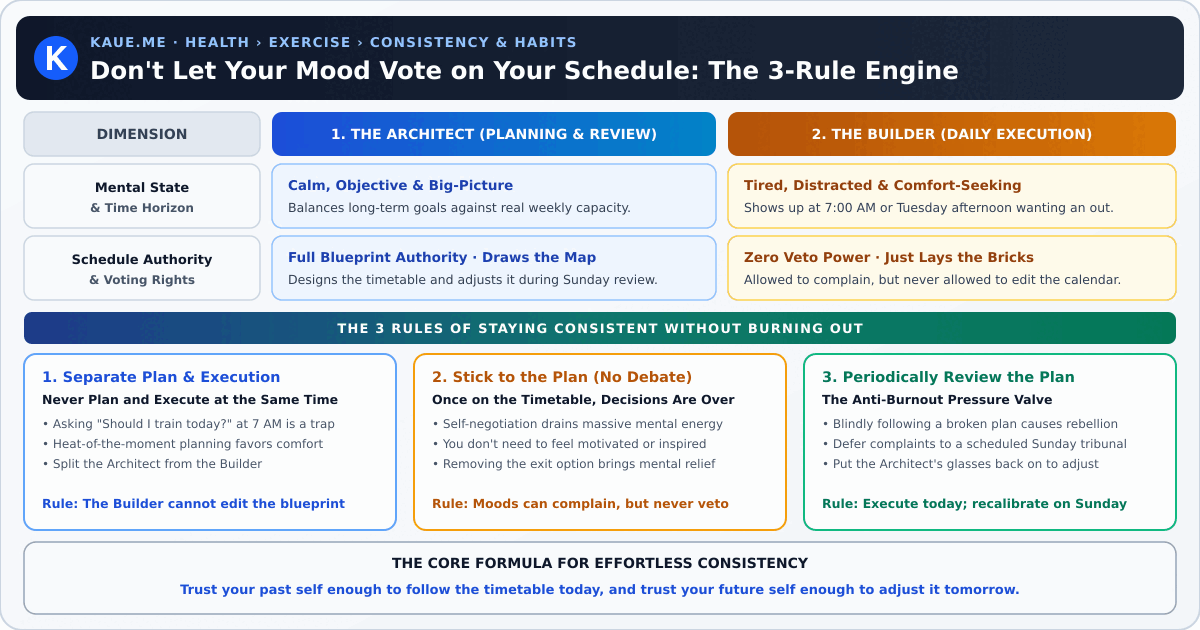
Separate planning from execution, during the execution stick to the plan, and periodically review the plan.
Those three rules are the entire engine behind staying consistent without burning out.
Most routines fall apart because people try to plan and execute at the exact same time. When 7:00 AM rolls around and they ask themselves, “Do I really need to work out today, or can I push it to tomorrow?”, they are letting their current mood renegotiate yesterday’s commitment.
To avoid this, I split myself into two distinct roles: The Architect and The Builder.
If you let the Builder redraw the blueprint in the heat of the moment, comfort will win almost every time. Separating planning from execution means the Builder isn’t allowed to edit the timetable: the Architect draws the map; the Builder just lays the bricks.
Once a task goes onto my timetable, the decision-making phase is officially over.
Negotiating with yourself is exhausting. Every time you pause to debate whether you feel like doing something on your schedule—“Should I go to the gym today, or push it to tomorrow? Maybe I’ll just do half an hour…"—you burn massive amounts of mental energy before you’ve even started the task.
When it’s time to execute, I take my mind’s fluctuating moods out of the equation (a practical application of Your Mind Is an Excellent Servant, But a Terrible Master ). I don’t need to feel motivated, inspired, or in the right headspace. My mind is allowed to complain, and it’s allowed to not want to be there—but it doesn’t get to dictate terms. Ironically, removing the option to back out brings a huge sense of mental relief: the calendar has already decided what happens next, and the debate is over before it even starts.
Strict execution without a pressure valve is a fast track to burnout. If you force yourself to blindly follow a broken schedule forever, you’ll eventually rebel against your own system.
That’s why the third rule—periodically reviewing the plan—is what makes the first two sustainable.
When your mind starts rebelling against a task on a Wednesday afternoon, it is infinitely easier to tell yourself, “We are doing this right now because it’s on the timetable, and if this schedule is too heavy, we won’t quit today—we’ll fix it during Sunday’s review,” than it is to feel trapped in an unbreakable routine. Your brain relaxes when it knows there is an upcoming, fair tribunal where its complaints will be heard.
During my periodic review, I take off the Builder’s hard hat and put the Architect’s glasses back on. I look objectively at what worked, where my energy dragged, and where I overcommitted (whether in my Exercise & Fitness Log or my weekly project lists). If a habit or time block genuinely isn’t working, that is the moment I change it—calmly and intentionally, rather than in the middle of a Tuesday afternoon slump.
Self-discipline isn’t about silencing your moods or becoming a robot. It’s about giving your mind the right time and place to speak.
Let your mind weigh in while you are designing the plan. Listen to its feedback when you sit down to review the plan. But in the space between the two—when the clock hits the time block—trust your past self enough to follow the timetable today, and trust your future self enough to adjust it tomorrow.
Get notified when I publish new essays, book summaries, and practical guides on living well. No spam—unsubscribe anytime.
Get the curated offline edition of Kaue's Way of Life—a practical field guide to optimizing 🍏 Health, 💰 Wealth, ❤️ Love, and 🧘 Meaning.
Have a question, perspective, or suggestion? Share your thoughts below. Comments are powered by GitHub Discussions (ad-free and spam-free)—click Sign in with GitHub below to comment or react (creating a free GitHub account takes less than a minute).
Updated on Nov 12, 2026.
DISCLAIMER: The content on this site is for informational and educational purposes only and does not constitute medical, psychological, financial, investment, tax, or legal advice. The ideas, curation, and opinions presented here are my own and do not represent those of my employer. Book, lecture, and article summaries are independent educational commentary and remain the intellectual property of their respective authors. AI tools may be used to assist with editing, formatting, and synthesis; while every effort is made to ensure accuracy, errors may occur. PRIVACY: This site uses third-party services for optional newsletter subscriptions (Mailchimp), comments (giscus / GitHub Discussions), and embedded media (YouTube), which may process visitor IP addresses and cookies in accordance with their respective privacy policies.